Proof Solving in Rocq: From First Proofs to Advanced Tactics
1. How to Use This Tutorial
A hands-on guide to writing proofs in Rocq, from your first reflexivity to the tactics used in real verification proofs. It follows the first three chapters of Logical Foundations (Software Foundations, Vol. 1), Basics → Induction → Lists, and then goes beyond them:
- Section 1, getting started: a tactic index, step-by-step setup in VS Code, the core proof loop, and a roadmap.
- Sections 2, 3 and 5, the book’s chapters: Basics, Induction and Lists, one idea per step, each with minimal code and the tactic it introduces.
- Section 4, advanced tactics: what real proofs need beyond the book’s first chapters: integers, automatic arithmetic with
lia,applyandassertfor helper facts,exfalsofor impossible cases, splitting “or” and “and”, unfolding definitions, and closing several goals at once withtryandall:. - Section 6, practice: 30 problems, from one-tactic warm-ups to challenges.
- Section 7, reference: hints, answers, a tactic cheat sheet, tips for when you are stuck, and a lemma dependency map.
1.1 Tactic index
Every tactic and command in this tutorial, in the order it is taught, with where it is explained. Tactics work inside a proof; commands are used outside proofs, or to wrap them.
| # | Tactic or command | Kind | What it does | Explained in |
|---|---|---|---|---|
| 1 | Compute e. | Command | Evaluate an expression | 2.1 |
| 2 | Check e. | Command | Show the type of an expression, constructor or lemma | 2.4 |
| 3 | intros n | Tactic | Move a forall variable or an assumption into the context | 2.10.2, 2.10.5 |
| 4 | simpl | Tactic | Run the definitions to simplify the goal; changes the goal you see | 2.10.2 |
| 5 | reflexivity | Tactic | Close a goal whose two sides are equal, computing if needed | 2.10.2 |
| 6 | Proof. / Qed. | Command | Start a proof / finish it and have Rocq recheck it | 2.10.3 |
| 7 | Admitted. | Command | Accept a claim without proof (placeholder only) | 2.10.6 |
| 8 | rewrite -> H / rewrite <- H | Tactic | Replace one side of an equation with the other, using a hypothesis | 2.11.1 |
| 9 | rewrite lemma | Tactic | The same, using an already-proved lemma | 2.11.2 |
| 10 | destruct n as [ … ] eqn:E | Tactic | Split the goal into one case per constructor. The optional as [ … ] names what each case carries; the optional eqn:E records which case you are in | 2.12.2–2.12.5 |
| 11 | intros with a pattern | Tactic | Shorthand for Row 3 + Row 10 | 2.12.7 |
| 12 | induction n | Tactic | Prove a base case, then a step that may use the induction hypothesis | 3.3 |
| 13 | replace e1 with e2 | Tactic | Swap one specific sub-term; prove the equality as a side goal | 3.5 |
| 14 | Search pattern. | Command | Find lemmas matching a pattern | 3.8 |
| 15 | assumption | Tactic | The goal is exactly one of the hypotheses | 4.2.1 |
| 16 | t1; t2 | Tactic | Run t2 on every goal t1 produces | 4.2.2 |
| 17 | lia | Tactic | Do integer/natural-number arithmetic automatically | 4.2.3 |
| 18 | subst | Tactic | Replace a variable by what a hypothesis says it equals | 4.2.4 |
| 19 | exfalso | Tactic | “This case is impossible”: show the hypotheses contradict | 4.2.5 |
| 20 | apply L | Tactic | Use lemma L; its premises become the new goals | 4.2.6 |
| 21 | assert (H : P) by tac | Tactic | Prove a helper fact on the spot and keep it as H | 4.2.7 |
| 22 | replace … in H | Tactic | replace inside a hypothesis | 4.2.8 |
| 23 | destruct on an “or” hypothesis | Tactic | One case per alternative of A \/ B \/ C | 4.2.9 |
| 24 | exact H / exact (L a b H) | Tactic | Close the goal with a named hypothesis, or a lemma applied to its arguments | 4.3.1 |
| 25 | split | Tactic | Prove an “and” (A /\ B) as two goals | 4.3.2 |
| 26 | intros … [H1 H2] / destruct H as [H1 H2] | Tactic | Split an “and” hypothesis into two hypotheses | 4.3.3 |
| 27 | unfold f in * / simpl in * / cbn | Tactic | Expand a definition, or simplify, in the goal and every hypothesis | 4.3.4 |
| 28 | apply (L a b c) and _ | Tactic | Give a lemma its arguments when apply can’t infer them; _ lets Rocq fill one in | 4.3.5 |
| 29 | try t / all: t | Tactic | Attempt a tactic without failing / run it on every open goal | 4.3.6 |
| 30 | induction l (lists) | Tactic | Induction on lists: [] case, then h :: t case | 5.6 |
1.2 Setup
- The current edition targets Rocq 9 (formerly Coq). Imports use
From Stdlib Require ...andFrom LF Require Export Basics. - Download the book’s
.vsources and work inside thelf/directory. Build a chapter before importing it:make Basics.vo, orrocq compile -Q . LF Basics.v. - Use an interactive IDE: VS Code + VsRocq, Proof General (Emacs), or RocqIDE. You step through a proof one sentence at a time and watch the goal panel change.
Step by step with VS Code
Install Rocq and the VsRocq language server (via opam; the Rocq Platform installer is an alternative). In a terminal:
1
2
3
opam install rocq-prover vsrocq-language-server
eval $(opam env)
which vsrocqtop        # should print a path
If opam picks versions that don’t match, pin Rocq first (e.g.
opam pin add rocq-core 9.1.0) as the VsRocq README describes.- Install the VS Code extension. Press F1, run Extensions: Install Extension, search for VsRocq, install it. If it reports that it cannot find
vsrocqtop, set"vsrocq.path"in Settings to the path printed bywhich vsrocqtop. Tip: launch VS Code from the same terminal (code .) so it sees your opam environment. - Download the book. From softwarefoundations.cis.upenn.edu, download the Logical Foundations archive and extract it. You get an
lf/folder withBasics.v,Induction.v,Lists.v,_CoqProjectand aMakefile. - Open the folder, not a single file. In VS Code use File → Open Folder on
lf/. VsRocq reads_CoqProject(which contains-Q . LF) from the folder root; that is what makesFrom LF Require Export Basics.resolve. Build once. Open the integrated terminal (Ctrl+`) and run:
1
2
make               # builds every chapter's .vo file
make Basics.vo     # or just one chapter
If there is no
Makefile, create one withrocq makefile -f _CoqProject *.v -o Makefile.- Step through a chapter. Open
Basics.v. VsRocq checks the file as you go; the goal panel on the right shows the context and goal at your cursor. Move the cursor line by line through a proof and watch the goal change. That is the main skill this tutorial assumes. - Do the practice problems in your own file. Create
Practice.vinsidelf/, start it withFrom LF Require Export Lists.(aftermake Lists.vo), then paste problems from Section 6 and replace eachAdmitted.with a proof.
If something breaks
- Cannot find a physical path bound to LF: you opened a single file rather than the
lf/folder, or the chapter’s.vois not built yet. - Compiled library … makes inconsistent assumptions: you edited an earlier chapter. Run
makeagain (ormake clean; make). - Works in the terminal but not in VS Code: VS Code is using a different Rocq install. Launch it from the terminal after
eval $(opam env), or setvsrocq.path.
1.3 The core loop
- State a claim with
Theorem,LemmaorExample. - Type
Proof., then apply tactics one at a time while reading the goal panel. - Finish with
Qed.when no subgoals remain. UseAdmitted.only as a temporary placeholder.
1.4 Roadmap
| Section | Programming idea | Proof idea | Key tactics |
|---|---|---|---|
| 2. Basics | Inductive types, match, Fixpoint | Simplification, rewriting, case analysis | intros, simpl, reflexivity, rewrite, destruct |
| 3. Induction | Reuses nat; adds double, binary bin | Induction, in-place helper facts, finding lemmas | induction, replace, Search |
| 4. Advanced Tactics | Integers (Z); your own Definitions of statements | Arithmetic automation, contradictions, helper facts, case splits on “or”, working with “and”, several goals at once | assumption, ;, lia, subst, exfalso, apply, assert, replace … in H, destruct on \/, exact, split, unfold, try, all: |
| 5. Lists | Pairs, lists, options, partial maps | Induction on lists | induction on lists |
| 6. Practice Problems | 30 exercises across Basics, Induction and Lists | Choosing between simplification, case analysis and induction | All of the above |
| 7. Hints, Answers and Cheat Sheet | Reference material | Hints, answers and a lemma dependency map | Tactic cheat sheet |
2. Basics: Functional Programming in Rocq
Rocq has almost nothing built in: booleans, numbers and even equality tests are user-defined. You learn two things here: writing programs in Gallina (Rocq’s functional language) and proving simple facts about them with tactics.
2.1 Step 1: Enumerated types and pattern matching
An Inductive declaration defines a type by listing its constructors. Functions inspect values with match.
1
2
3
4
5
6
7
8
9
10
11
12
13
14
15
16
17
18
19
Inductive day : Type :=
  | monday
  | tuesday
  | wednesday
  | thursday
  | friday
  | saturday
  | sunday.

Definition next_working_day (d : day) : day :=
  match d with
  | monday => tuesday
  | tuesday => wednesday
  | wednesday => thursday
  | thursday => friday
  | friday => monday
  | saturday => monday
  | sunday => monday
  end.
There are three ways to test a function:
- Compute it:
Compute (next_working_day friday).printsmonday : day. - State an Example and prove it:
Example test : next_working_day (next_working_day saturday) = tuesday. Proof. simpl. reflexivity. Qed. - Extract it to OCaml, Haskell or Scheme (covered in later chapters).
2.2 Step 2: Booleans, notation and conditionals
bool is just another two-constructor type. Functions over it are truth tables written as matches.
1
2
3
4
5
6
7
8
9
10
11
12
13
14
15
16
17
18
19
20
21
22
23
24
Inductive bool : Type :=
  | true
  | false.

Definition negb (b : bool) : bool :=
  match b with
  | true => false
  | false => true
  end.

Definition andb (b1 b2 : bool) : bool :=
  match b1 with
  | true => b2
  | false => false
  end.

Definition orb (b1 b2 : bool) : bool :=
  match b1 with
  | true => true
  | false => b2
  end.

Notation "x && y" := (andb x y).
Notation "x || y" := (orb x y).
Notationadds infix syntax; it does not change the definition.- Note that
andbandorbonly match onb1. This detail matters later:simplgets stuck when the first argument is an unknown variable.
2.3 Step 3: Conditionals (if-then-else)
On booleans, if works exactly as in any other language. Under the hood, though, it is shorthand for a match, and that is why it also works on types that are not bool.
2.3.1 Example on bool
First define bool with an Inductive declaration, exactly like day: a type with two constructors, true and false. Then write negb, andb and orb with if instead of match:
1
2
3
4
5
6
7
8
9
10
11
12
13
14
15
16
17
18
Inductive bool : Type :=
  | true
  | false.

Definition negb' (b : bool) : bool :=
  if b then false
  else true.

Definition andb' (b1 b2 : bool) : bool :=
  if b1 then b2
  else false.

Definition orb' (b1 b2 : bool) : bool :=
  if b1 then true
  else b2.

Example test_andb' : andb' true false = false.
Proof. reflexivity. Qed.
They compute the same results as the match versions in Step 2.
2.3.2 Example on any inductive type with two values
Under the hood, if takes the then-branch when the value is the first constructor declared in its type. So if works on any inductive type with exactly two constructors. Here is a black-and-white type:
1
2
3
4
5
6
7
8
9
10
Inductive bw : Type :=
  | bw_black
  | bw_white.

Definition invert (x : bw) : bw :=
  if x then bw_white
  else bw_black.

Compute (invert bw_black).   (* ==> bw_white : bw *)
Compute (invert bw_white).   (* ==> bw_black : bw *)
Here if x then ... means “if x is bw_black”, because bw_black is declared first. Nothing about bw_black is “true”; it is just first.
2.3.3 The catch
If you reorder the constructors (| bw_white | bw_black), invert silently flips its meaning and still type-checks.
2.4 Step 4: Types and Check
Check e prints the type of e. Functions are values with arrow types: negb : bool -> bool, andb : bool -> bool -> bool.
1
2
3
4
5
6
7
8
9
10
11
12
13
14
15
Check true.
(* ===> true : bool *)

Check (negb true).
(* ===> negb true : bool *)

Check negb.
(* ===> negb : bool -> bool *)

Check andb.
(* ===> andb : bool -> bool -> bool *)

(* Add ": type" to have Rocq verify the type you expect *)
Check (andb true false) : bool.   (* accepted *)
Check true : day.                 (* error: true has type bool, not day *)
Read bool -> bool -> bool as “give me two bools and I return a bool”.
negb true has type bool (not bool -> bool) because the function has already been applied to its argument.
2.5 Step 5: Constructors with arguments
A constructor can carry data. primary takes an rgb value.
2.5.1 A constructor that carries data
1
2
3
4
5
6
7
8
9
10
11
12
13
14
15
Inductive rgb : Type :=
  | red
  | green
  | blue.

Inductive color : Type :=
  | black
  | white
  | primary (p : rgb).

Definition isred (c : color) : bool :=
  match c with
  | primary red => true
  | _ => false
  end.
_ is a wildcard pattern. In isred it matches every value not caught by the branch above it, i.e. everything except primary red.
The line | primary (p : rgb) declares a constructor primary that takes one rgb value. So color has exactly five values:
1
2
3
4
5
black
white
primary red
primary green
primary blue
1
2
3
Check primary.
(* ===> primary : rgb -> color *)
(* give it an rgb, get a color *)
Declaring the Inductive makes primary a global name you can use anywhere after it, in this file and in files that import it.
2.5.2 Matching on a constructor with an argument
A match can cover all three primaries in one branch. p is just a name for whichever rgb is inside:
1
2
3
4
5
6
Definition monochrome (c : color) : bool :=
  match c with
  | black => true
  | white => true
  | primary p => false   (* covers red, green and blue at once *)
  end.
2.6 Step 6: Modules
Module X. ... End X. scopes names, so later code refers to X.foo.
Example of Module: two definitions can share the name foo because one lives inside the module.
1
2
3
4
5
6
7
8
Module Playground.
  Definition foo : rgb := blue.
End Playground.

Definition foo : bool := true.

Check Playground.foo : rgb.   (* the one inside the module *)
Check foo : bool.             (* the one outside *)
Step 8 (Natural numbers) relies on this: the book defines its own nat inside Module NatPlayground, so it does not clash with the standard library’s nat.
2.7 Step 7: Tuples
A single constructor with several arguments acts as a tuple, e.g. bits (b0 b1 b2 b3 : bit) for a nybble.
1
2
3
4
5
6
7
8
9
10
11
12
13
14
15
16
17
18
Inductive bit : Type :=
  | B1
  | B0.

Inductive nybble : Type :=
  | bits (b0 b1 b2 b3 : bit).   (* one constructor, four fields *)

Check (bits B1 B0 B1 B0) : nybble.

(* Pattern matching unwraps the four fields *)
Definition all_zero (nb : nybble) : bool :=
  match nb with
  | bits B0 B0 B0 B0 => true
  | bits _ _ _ _ => false
  end.

Compute (all_zero (bits B1 B0 B1 B0)).   (* ==> false *)
Compute (all_zero (bits B0 B0 B0 B0)).   (* ==> true *)
2.8 Step 8: Natural numbers (unary)
2.8.1 The idea: tally marks
Think of counting with tally marks. Zero is “no marks”. Every larger number is “one more mark than the number before”.
Rocq writes numbers exactly this way, with two constructors:
O(the letter O) means zero.Smeans one more than.Sstands for successor.
2.8.2 The definition
1
2
3
4
5
Module NatPlayground.   (* so our nat doesn't clash with the library's *)

Inductive nat : Type :=
  | O
  | S (n : nat).
This has the same shape as color in Step 2.5:
primary (p : rgb)takes anrgband makes acolor.S (n : nat)takes anatand makes anat.
The only new thing is that S takes a value of the type being defined. That is what lets nat grow forever.
2.8.3 Building numbers one step at a time
1
2
3
4
O              (* 0 *)
S O            (* 1  = one more than 0 *)
S (S O)        (* 2  = one more than 1 *)
S (S (S O))    (* 3  = one more than 2 *)
color has exactly five values. nat has infinitely many, because you can always wrap one more S around a number.
Where does “3” come from? Nothing in the definition says S (S (S O)) is three. The definition only says how to write a nat: some Ss followed by an O. The names are arbitrary; stop and tick would work just as well.
The meaning “S = one more” comes from how we use it. Functions like pred (below) and plus (Step 2.9) are written to treat each S as +1. That is what makes S (S (S O)) behave like three.
The digit 3 is a separate convenience built into Rocq, and it only applies to the standard library’s nat, not our copy. For that type, Rocq reads 3 as S (S (S O)) and prints it back as 3:
1
2
3
(* outside NatPlayground, using the library's nat *)
Check (S (S (S O))).
(* ===> 3 : nat *)
Inside NatPlayground the same Check prints S (S (S O)) : nat, because Rocq has no digit notation for our own nat.
2.8.4 S stores, it doesn’t compute
S O does not run anything to produce 1. Like primary red, it is the value: a piece of data. Rocq never simplifies S O further; it is already as simple as it gets.
2.8.5 A first function: pred (subtract one)
1
2
3
4
5
6
7
Definition pred (n : nat) : nat :=
  match n with
  | O => O
  | S n' => n'
  end.

End NatPlayground.
Read the two branches in plain words:
- If
nis zero, answer zero (there is nothing smaller). - If
nis “one more than somen'”, answern'. In other words, peel off oneS.
For example, pred (S (S O)) matches the second branch with n' = S O, so the answer is S O. In digits: pred 2 = 1.
2.9 Step 9: Recursive functions with Fixpoint
Recursive functions use Fixpoint. Rocq requires structural recursion: each recursive call must be on a strictly smaller piece of the input, so every function terminates.
1
2
3
4
5
6
7
8
9
10
11
12
13
14
15
16
17
18
19
20
21
22
23
24
25
Fixpoint even (n : nat) : bool :=
  match n with
  | O => true
  | S O => false
  | S (S n') => even n'
  end.

Fixpoint plus (n m : nat) : nat :=
  match n with
  | O => m
  | S n' => S (plus n' m)
  end.

Fixpoint mult (n m : nat) : nat :=
  match n with
  | O => O
  | S n' => plus m (mult n' m)
  end.

Fixpoint eqb (n m : nat) : bool :=
  match n, m with
  | O, O => true
  | S n', S m' => eqb n' m'
  | _, _ => false
  end.
Trace of plus 3 2: S (plus 2 2) → S (S (plus 1 2)) → S (S (S (plus 0 2))) → 5.
Writing plus 3 2 as 3 + 2. Typing plus, mult and eqb everywhere gets clumsy, so the book adds Notation declarations. This is the same idea as && and || for booleans in Step 2:
1
2
3
4
5
Notation "x + y"   := (plus x y)  (at level 50, left associativity) : nat_scope.
Notation "x - y"   := (minus x y) (at level 50, left associativity) : nat_scope.
Notation "x * y"   := (mult x y)  (at level 40, left associativity) : nat_scope.
Notation "x =? y"  := (eqb x y)   (at level 70) : nat_scope.
Notation "x <=? y" := (leb x y)   (at level 70) : nat_scope.
- A notation only changes how you type and read the code.
3 + 2is stillplus 3 2underneath. levelsets the precedence of which operator executes first: a lower level goes first. So1 + 2 * 3means1 + (2 * 3).
= versus =?. They look alike but are different things:
x =? yis a boolean computation.Compute (2 =? 3).givesfalse.x = yis a claim that you prove. Step 10 shows how.
2.10 Step 10: What a proof is, and proof by simplification (intros, simpl, reflexivity)
2.10.1 What a proof is in Rocq
Rocq is a proof checker. You state a claim, then give step-by-step instructions that convince Rocq the claim is true. Rocq accepts the proof only if every step is valid.
This is stronger than testing. Compute (plus 0 5). checks one input. A theorem with forall covers every input at once.
2.10.2 Tactics: the commands inside a proof
A tactic is one instruction to Rocq inside a proof, like “do this step next”. Each tactic changes what is left to prove. This step uses only three:
| Tactic | In plain words | What it does to the claim |
|---|---|---|
intros n | “Let n be any number.” | forall n, 0 + n = n becomes 0 + n = n, for one arbitrary n |
simpl | “Simplify.” Run the function definitions as far as they go. Compute (0 + 5). turns 0 + 5 into 5; simpl does the same on the claim, even though n is unknown. | 0 + n = n becomes n = n, because the standard library’s plus returns the second number when the first is 0 |
reflexivity | “Both sides are the same, so we’re done.” | Closes any claim of the form a = a |
Key difference between simpl and reflexivity:
simplchanges the goal you see and then stops, leaving the simplified goal for your next tactic.reflexivitynever shows you a simplified goal. It either finishes or fails.
Every proof sits between Proof. and Qed.. These are the same three words you saw in earlier examples (Proof. simpl. reflexivity. Qed.). Step 2.10.5 walks through them on a real example and shows what VS Code displays after each one.
2.10.3 The parts of a proof
1
2
3
4
5
6
Theorem plus_O_n : forall n : nat, 0 + n = n.   (* 1. a name and a claim *)
Proof.                                         (* 2. start the proof     *)
  intros n.                                    (* 3. tactics, one by one *)
  simpl.
  reflexivity.
Qed.                                           (* 4. Rocq checks and saves it *)
- The claim.
plus_O_nis its name.forall n : nat, 0 + n = nreads “for every natural numbern,0 + nequalsn”.Theorem,LemmaandExampleall mean the same thing to Rocq. Proof.opens the proof.- Tactics are the instructions. Each one changes what is left to prove.
Qed.ends the proof. Rocq rechecks everything and records the theorem so later proofs can use it.
Note that = here is a claim you prove, not the boolean test =? from Step 2.9.
2.10.4 The proof state: context and goal
While you are inside a proof, the goal panel in VS Code shows the proof state. It has two parts, separated by a line:
- Above the line: the context. Things you are allowed to assume.
- Below the line: the goal. What you still have to show.
Right after Proof., nothing is assumed yet:
1
2
3
(* context: empty *)
============================
forall n : nat, 0 + n = n
The proof is finished when no goals remain. (The exact look of the panel varies a little by editor.)
2.10.5 Walking through the proof, one tactic at a time
intros n means “let n be some arbitrary number”. It moves n from the goal into the context:
1
2
3
n : nat
============================
0 + n = n
simpl runs the definitions as far as possible. plus matches on its first argument. Here that is 0, so the first branch fires and 0 + n becomes n:
1
2
3
n : nat
============================
n = n
reflexivity closes a goal whose two sides are identical. Rocq reports No more goals, and Qed. saves the theorem.
2.10.6 Good to know
reflexivitysimplifies on its own, sosimplis often optional. It is useful for seeing the intermediate goal.- An
Examplelikenext_working_day saturday = mondayis the same kind of proof with noforall: there is nothing to introduce. Admitted.accepts a claim without proof. It is a placeholder for exercises, and dangerous elsewhere.n + 0 = ncannot be proved this way:plusmatches onn, which is unknown. That needsdestruct(Step 2.12) or induction (Section 3).
Worked example: a proof with no forall. Here is the Example from the bullet above, step by step.
1
2
3
4
5
Example test_saturday : next_working_day saturday = monday.
Proof.
  simpl.
  reflexivity.
Qed.
After
Proof.There is noforall, so there is nothing to introduce and the context is empty:1 2
============================ next_working_day saturday = monday
After
simpl.next_working_daymatches on its argument. The argument issaturday, so thesaturday => mondaybranch fires:1 2
============================ monday = monday
After
reflexivity. Both sides are identical, so the goal closes. Rocq reports No more goals, andQed.savestest_saturday.
Compare with plus_O_n in 2.10.5: same simpl then reflexivity, but no intros step, because the claim is about one specific day rather than every number.
2.11 Step 11: Proof by rewriting (rewrite)
rewrite replaces an expression in the goal with another one known to be equal to it. This is the ordinary rule of substituting equals for equals: swapping two equal things cannot change whether a statement is true.
Precondition: rewrite needs an equation a = b to rewrite with. It can come from one of two places:
- a hypothesis in the context, like
H : n = m, or - an already-proved lemma, like
mult_n_O : forall n, 0 = n * 0. A proved theorem is a fact you are entitled to use.
Without such an equation, rewrite fails: Rocq won’t swap terms it hasn’t been told are equal.
2.11.1 Rewriting with a hypothesis
1
2
3
4
5
6
7
Theorem plus_id_example : forall n m : nat,
  n = m -> n + n = m + m.
Proof.
  intros n m H.   (* H : n = m *)
  rewrite -> H.   (* goal becomes m + m = m + m *)
  reflexivity.
Qed.
Reading the example with these points:
- The claim is
forall n m : nat, n = m -> n + n = m + m. Read->as if … then: ifn = m, thenn + n = m + m. The theorem promises nothing whennandmdiffer. intros n m Htakesnandmas arbitrary numbers, and takes the assumptionn = minto the context under the nameH. We never proven = m; we are allowed to assume it.- So
H : n = mis the equation thatrewriteneeds. Here it comes from a hypothesis. rewrite -> Hsubstitutesmforn, givingm + m = m + m, andreflexivitycloses it.
Which way does rewrite go? A hypothesis like H : n = m has a left side (n) and a right side (m):
rewrite -> H(or justrewrite H): find the left sidenin the goal and replace it with the right sidem.rewrite <- H: the reverse. Find the right sidemand replace it with the left siden.
In the proof above, with H : n = m and goal n + n = m + m, both directions work:
1
2
3
4
5
(* rewrite -> H : every n becomes m *)
m + m = m + m        (* reflexivity closes it *)

(* rewrite <- H : every m becomes n *)
n + n = n + n        (* reflexivity closes it too *)
Direction matters when only one side appears in the goal. If the goal mentions m but not n, then rewrite -> H fails, because there is no n to find. You would need rewrite <- H.
2.11.2 Rewriting with a proved lemma
The second source of equations is a lemma that is already proved. The standard library proves this one:
1
2
Check mult_n_O.
(* ===> mult_n_O : forall n : nat, 0 = n * 0 *)
You can rewrite with it exactly like a hypothesis:
1
2
3
4
5
6
7
8
Theorem mult_n_0_m_0 : forall p q : nat,
  (p * 0) + (q * 0) = 0.
Proof.
  intros p q.
  rewrite <- mult_n_O.   (* p * 0 becomes 0 *)
  rewrite <- mult_n_O.   (* q * 0 becomes 0 *)
  reflexivity.           (* 0 + 0 = 0 *)
Qed.
- Why
<-? The lemma reads0 = n * 0. We want to replacen * 0(its right side) with0(its left side), which is right-to-left. - Where does
ncome from? The lemma says “for alln”. Rocq fills innby matching the pattern_ * 0against the goal: first it findsp * 0, son=p. - Why two rewrites? Each
rewritefixesnto a single value. The first handlesp * 0and the second handlesq * 0.
2.12 Step 12: Proof by case analysis (destruct)
2.12.1 The problem: simpl gets stuck
Take the claim “n + 1 is never zero”, written with the boolean test =?:
1
2
3
4
5
6
Theorem plus_1_neq_0_firsttry : forall n : nat,
  (n + 1) =? 0 = false.
Proof.
  intros n.
  simpl.   (* does nothing! *)
Abort.
simpl makes no progress because:
+decides what to do by looking at its first number. Here that isn, which is unknown, so Rocq can’t pick a branch.=?also looks at its first argument,n + 1, which is stuck for the same reason.
Compare 0 + n in Step 10: there the first number was 0, a known constructor, so simpl could run.
2.12.2 The idea: check every possible shape of n
From Step 8, every nat has one of exactly two shapes:
O(zero), orS n'(one more than some numbern').
If the claim holds for both shapes, it holds for every number. The tactic destruct n does this split: it replaces the one goal with one goal per constructor.
2.12.3 The proof
1
2
3
4
5
6
7
8
9
10
Theorem plus_1_neq_0 : forall n : nat,
  (n + 1) =? 0 = false.
Proof.
  intros n.
  destruct n as [| n'] eqn:E.
  - (* case 1: n is O *)
    reflexivity.
  - (* case 2: n is S n' *)
    reflexivity.
Qed.
2.12.4 Walking through it, one step at a time
After intros n, there is one goal, and it is stuck:
1
2
3
n : nat
============================
(n + 1) =? 0 = false
After destruct n as [| n'] eqn:E, there are now two goals.
Goal 1, where n is zero:
1
2
3
4
n : nat
E : n = 0
============================
(0 + 1) =? 0 = false
Goal 2, where n is one more than some n':
1
2
3
4
n, n' : nat
E : n = S n'
============================
(S n' + 1) =? 0 = false
Case 1: reflexivity. Everything is known: 0 + 1 computes to 1, and 1 =? 0 computes to false. Both sides are false, so the goal closes.
Case 2: reflexivity. n' is still unknown, but now + sees S in front. So S n' + 1 computes to S (n' + 1): some number starting with S. That is enough for =?: anything of the form S … compared with 0 is false. The goal closes, and Rocq reports No more goals.
2.12.5 Reading the destruct line piece by piece
destruct n: split on the shape ofn, one goal per constructor.as [| n']: names for what each constructor carries, one slot per constructor, separated by|.Ocarries nothing, so its slot (before the|) is empty.Scarries one number, which we namen'.eqn:E: record which case you are in as a hypothesisE(n = 0orn = S n'). It is optional, but it helps you keep track.
2.12.6 Bullets: keeping the cases apart
Each - starts the proof of one goal. Rocq makes you finish that goal before moving to the next -, so the cases can’t get mixed up.
If you destruct again inside a case, use a different symbol (+, then *) for the inner level. Here is a proof with two booleans:
1
2
3
4
5
6
7
8
9
10
11
12
Theorem andb_commutative : forall b c : bool,
  andb b c = andb c b.
Proof.
  intros b c.
  destruct b eqn:Eb.
  - destruct c eqn:Ec.
    + reflexivity.   (* b = true,  c = true  *)
    + reflexivity.   (* b = true,  c = false *)
  - destruct c eqn:Ec.
    + reflexivity.   (* b = false, c = true  *)
    + reflexivity.   (* b = false, c = false *)
Qed.
bool’s constructors carry nothing, so noas [...]is needed.- Two booleans give four cases: one row of the truth table each.
2.12.7 Shorthand
Destructing right after introducing is so common that Rocq has a shortcut:
intros [| n'].introducesnand destructs it in one step (but gives you noEequation).intros [] [].does the same for two booleans, giving the four cases above.
For each variable you split, use one [] pattern in that variable’s position.
Example 1: one variable, any name.
1
2
3
4
5
6
7
Theorem plus_1_neq_0'' : forall n : nat,
  (n + 1) =? 0 = false.
Proof.
  intros [| k].    (* splits n, the 1st variable; calls the smaller number k *)
  - reflexivity.   (* goal: (0 + 1) =? 0 = false   *)
  - reflexivity.   (* goal: (S k + 1) =? 0 = false *)
Qed.
Writing k instead of n' changes nothing except the name shown in case 2.
Example 2: two variables, choose which one to split.
1
2
3
4
5
6
7
Theorem andb_false_r' : forall b c : bool,
  andb b false = false.
Proof.
  intros [] c.     (* 1st position is b: split it; c is just named *)
  - reflexivity.   (* goal: andb true false = false  *)
  - reflexivity.   (* goal: andb false false = false *)
Qed.
Here b is split because the pattern [] is in the first slot. If you wrote intros b [] instead, c would be split and b would stay unknown.
2.13 Step 13: Fixpoints and structural recursion, revisited
Rocq checks that some argument decreases on every recursive call. A function that terminates but recurses on a value that is not a sub-term (for example n - 1 instead of n') is rejected. The fix is to restructure the match so the recursion follows the shape of the data.
2.14 Practice problems for Basics
Hints for each are in Section 7.4.
P1. ★ weekend (new). Define a function and prove two tests.
1
2
3
Definition weekend (d : day) : bool. (* := ... *) Admitted.
Example test_weekend1 : weekend saturday = true. Admitted.
Example test_weekend2 : weekend tuesday = false. Admitted.
P2. ★ nandb, andb3 (book). nandb b1 b2 is true when at least one input is false; andb3 is true when all three are true. Define both with match.
P3. ★ factorial and ltb (book).
1
2
3
4
Fixpoint factorial (n : nat) : nat. (* := ... *) Admitted.
Example test_factorial2 : factorial 5 = mult 10 12. Admitted.
Definition ltb (n m : nat) : bool. (* use leb, no new Fixpoint *) Admitted.
Example test_ltb3 : ltb 4 2 = false. Admitted.
P4. ★ Free proofs by computation (new). Each needs only intros and reflexivity. Explain to yourself why simpl can make progress.
1
2
3
Theorem orb_true_l : forall b : bool, true || b = true. Admitted.
Theorem leb_0_n    : forall n : nat, 0 <=? n = true. Admitted.
Theorem even_SS    : forall n : nat, even (S (S n)) = even n. Admitted.
P5. ★ plus_id_exercise and mult_n_1 (book).
1
2
3
4
Theorem plus_id_exercise : forall n m o : nat,
  n = m -> m = o -> n + m = m + o. Admitted.
Theorem mult_n_1 : forall p : nat, p * 1 = p.
(* use mult_n_Sm and mult_n_O *) Admitted.
P6. ★★ De Morgan for booleans (new).
1
2
Theorem negb_andb : forall b c : bool,
  negb (andb b c) = orb (negb b) (negb c). Admitted.
P7. ★★ andb_true_elim2 (book).
1
2
Theorem andb_true_elim2 : forall b c : bool,
  andb b c = true -> c = true. Admitted.
P8. ★★ identity_fn_applied_twice and andb_eq_orb (book).
1
2
3
4
5
6
7
Theorem identity_fn_applied_twice :
  forall (f : bool -> bool),
  (forall (x : bool), f x = x) ->
  forall (b : bool), f (f b) = b. Admitted.

Theorem andb_eq_orb : forall (b c : bool),
  (andb b c = orb b c) -> b = c. Admitted.
P9. ★★★ binary (book). Define incr : bin -> bin and bin_to_nat : bin -> nat for Inductive bin := Z | B0 (n : bin) | B1 (n : bin). (least significant bit first). Test: bin_to_nat (incr (incr (B1 Z))) = 3.
3. Induction: Proof by Induction
Case analysis splits a number into 0 and S n', but leaves you stuck again on n'. Induction fixes this: in the S n' case you get to assume the claim already holds for n'.
3.1 Step 1: Import the previous chapter
1
From LF Require Export Basics.
This needs a compiled Basics.vo. Put -Q . LF in _CoqProject, then run make Basics.vo (or rocq compile -Q . LF Basics.v). If you edit Basics.v, recompile everything that depends on it, or you will see “inconsistent assumptions” errors.
3.2 Step 2: See why destruct is not enough
0 + n = n is easy because plus matches on its first argument. n + 0 = n is not:
1
2
3
4
5
6
Theorem add_0_r_secondtry : forall n : nat, n + 0 = n.
Proof.
  intros n. destruct n as [| n'] eqn:E.
  - reflexivity.          (* 0 + 0 = 0: fine *)
  - simpl.                (* S (n' + 0) = S n': stuck on n' + 0 *)
Abort.
You could destruct n' again, but n can be arbitrarily large, so this never ends.
3.3 Step 3: Use induction
The principle: prove P(0), then prove P(n') -> P(S n'); conclude P(n) for all n.
1
2
3
4
5
6
Theorem add_0_r : forall n : nat, n + 0 = n.
Proof.
  intros n. induction n as [| n' IHn'].
  - (* n = 0 *)    reflexivity.
  - (* n = S n' *) simpl. rewrite -> IHn'. reflexivity.
Qed.
What happens in each subgoal:
- Base case:
nbecomes0; the goal is0 + 0 = 0. - Inductive case:
nbecomesS n', and the context gainsIHn' : n' + 0 = n'. Aftersimpl, the goal isS (n' + 0) = S n';rewrite -> IHn'finishes it.
The intro pattern [| n' IHn'] names the new variable and the induction hypothesis in the second case. The intros n is optional: induction introduces quantified variables itself.
What IHn' is. IHn' is the induction hypothesis: the claim itself, assumed true for the smaller number n'. In the inductive case of add_0_r, the goal panel shows:
1
2
3
4
n' : nat
IHn' : n' + 0 = n'          (* assumed: the claim for n' *)
============================
S n' + 0 = S n'             (* to prove: the claim for S n' *)
The name IHn' is just a label you choose in the pattern, like n'. The second slot of [| n' IHn'] holds two names because the S case gives you two things: the smaller number and the hypothesis about it.
3.4 Step 4: The standard first lemmas
These build on each other. Prove them in order, because later ones rewrite with earlier ones.
1
2
3
4
5
Theorem minus_n_n : forall n, minus n n = 0.
Theorem mul_0_r   : forall n : nat, n * 0 = 0.
Theorem plus_n_Sm : forall n m : nat, S (n + m) = n + (S m).
Theorem add_comm  : forall n m : nat, n + m = m + n.
Theorem add_assoc : forall n m p : nat, n + (m + p) = (n + m) + p.
add_comm needs both add_0_r (base case) and plus_n_Sm (inductive case). This pattern recurs constantly: when the inductive step gets stuck, the missing piece is usually a separate lemma.
3.5 Step 5: Proofs within proofs (replace)
Sometimes you need a small fact that does not deserve its own lemma. replace e1 with e2 swaps e1 for e2 in the goal and adds a second subgoal e1 = e2.
1
2
3
4
5
6
7
8
Theorem plus_rearrange : forall n m p q : nat,
  (n + m) + (p + q) = (m + n) + (p + q).
Proof.
  intros n m p q.
  replace (n + m) with (m + n).
  - reflexivity.                    (* main goal, now trivial *)
  - rewrite add_comm. reflexivity.  (* side goal: m + n = n + m *)
Qed.
Why use replace here instead of just rewrite add_comm?
The only difference between the two sides of the goal is n + m versus m + n, so we want to swap just that inner sum:
1
(n + m) + (p + q) = (m + n) + (p + q)
But the goal contains several + signs, and rewrite uses the first sum it finds, scanning from the outside in. The first one is the whole left side:
1
2
(n + m) + (p + q)
└─ a ─┘   └─ b ─┘     (* the OUTER +, with a = n + m, b = p + q *)
So rewrite add_comm swaps a and b and produces:
1
(p + q) + (n + m) = (m + n) + (p + q)
That’s true, but it’s no progress: the wrong + was swapped. There are two ways to hit the right one:
replace (n + m) with (m + n). You name the exact sub-term to change. This is what the proof above does.rewrite (add_comm n m). You give the lemma its arguments, so it can only meann + m = m + n.rewritethen changes exactly that sub-term, leaving(m + n) + (p + q) = (m + n) + (p + q)forreflexivity.
3.6 Step 6: Formal vs. informal proofs
The chapter’s motto: informal proofs are algorithms; formal proofs are code. A good informal proof states the induction explicitly and reminds the reader of the current goal at each step:
Informal Proof
Theorem: For any n, m, p: n + (m + p) = (n + m) + p. Proof: By induction on n.
- Suppose n = 0. We must show 0 + (m + p) = (0 + m) + p. This follows from the definition of +.
- Suppose n = S n’, with IH n’ + (m + p) = (n’ + m) + p. We must show S n’ + (m + p) = (S n’ + m) + p. By the definition of +, this is S (n’ + (m + p)) = S ((n’ + m) + p), which follows from the IH. Qed.
Do not just translate tactics into English. Say what is being shown and why it holds.
3.7 Step 7: Binary numbers, revisited
The chapter ends by proving properties of the bin type from Basics:
1
2
3
4
Inductive bin : Type :=
  | Z
  | B0 (n : bin)
  | B1 (n : bin).
bin_to_nat_pres_incr:bin_to_nat (incr b) = 1 + bin_to_nat b. Converting commutes with incrementing.nat_bin_nat:bin_to_nat (nat_to_bin n) = n. Uses the previous lemma.- The reverse direction fails:
B0 ZandZboth mean zero, so a round trip does not return the originalbin. The fix is anormalizefunction, and the advanced exercise provesnat_to_bin (bin_to_nat b) = normalize b.
Lesson: the shape of an induction proof follows the shape of the recursion, so keep your function definitions as simple as possible.
3.8 Step 8: Search
Search finds lemmas you have forgotten:
Search plus.lists every lemma mentioningplus.Search (_ + _ = _ + _).matches a shape;_is a wildcard.Search (?x + ?y = ?y + ?x).uses pattern variables (?x) to require repeated subterms.Search (_ + _ = _ + _) inside Induction.restricts to one module.
4. Advanced Tactics
This section covers advanced topics that go beyond the first three chapters: integers (Z) and the further tactics that real verification proofs rely on. Each tactic is explained with a small example.
Prerequisites: all of Section 2, plus 3.5 (replace).
4.1 Integers: Z and %Z
So far every number was a nat: 0, 1, 2, …, never negative. C programs use int, which can be negative, so verification lemmas use Rocq’s integer type Z.
1
2
3
4
From Stdlib Require Import ZArith Lia.   (* integers, and the lia tactic *)

Check (-9)%Z.        (* ===> -9 : Z *)
Check Z.abs.         (* ===> Z.abs : Z -> Z   (absolute value) *)
%Zmeans “read this number as an integer, not anat”. Verification lemmas write10%Z,(-9%Z)and so on for this reason.Z.abs i1is the absolute value |i1|.is_sint32 xis not part of Rocq. It comes from Frama-C, a tool that generates such lemmas, and means “xfits in a signed 32-bitint”.
4.2 Advanced tactics
Each tactic below has a one-line description and a small example, simplest first. The examples use nat, as in Section 2, and need From Stdlib Require Import Lia. at the top of the file.
4.2.1 assumption
In plain words: “The goal is literally one of my hypotheses.”
1
2
3
4
5
6
Theorem ex_assumption : forall n : nat,
  n = 3 -> n = 3.
Proof.
  intros n H.
  assumption.
Qed.
After intros n H, the goal is exactly hypothesis H:
1
2
3
4
n : nat
H : n = 3
============================
n = 3
assumption finds H and closes the goal.
4.2.2 t1; t2: run a tactic on every resulting goal
In plain words: Run t1, then run t2 on every goal t1 leaves.
1
2
3
4
5
6
Theorem ex_seq : forall b : bool,
  andb b true = b.
Proof.
  intros b.
  destruct b; reflexivity.
Qed.
destruct bcreates two goals:andb true true = trueandandb false true = false.; reflexivityrunsreflexivityon both, so no bullets are needed.
Without ; you would write destruct b. and then - reflexivity. twice.
4.2.3 lia: automatic arithmetic
In plain words: lia is a helper library that generates the proof for you. It handles goals built from +, -, <=, <, = and constants, using the hypotheses.
1
2
3
4
5
6
Theorem ex_lia : forall n m : nat,
  n <= m -> n < m + 1.
Proof.
  intros n m H.
  lia.
Qed.
The goal before lia:
1
2
3
4
n, m : nat
H : n <= m
============================
n < m + 1
lia generates a proof that n <= m implies n < m + 1 and closes the goal in one step. No rewrite or induction is needed. Rocq’s kernel still checks the generated proof, just like a hand-written one.
Its limit: lia treats a product of two unknowns, like n * n, as one opaque quantity. So it cannot prove forall n : nat, n <= n * n, even though it is true.
4.2.4 subst: substitute a variable away
In plain words: If a hypothesis says x = e, replace x with e everywhere: in the goal and in every hypothesis.
1
2
3
4
5
6
7
Theorem ex_subst : forall n m : nat,
  n = m + 1 -> n - 1 = m.
Proof.
  intros n m H.
  subst.
  lia.
Qed.
Before subst:
1
2
3
4
n, m : nat
H : n = m + 1
============================
n - 1 = m
After subst: H says n equals m + 1, so every n is replaced and H disappears:
1
2
3
m : nat
============================
m + 1 - 1 = m
Then lia closes it.
subst versus rewrite H:
rewrite Hreplaces every match, but only in the goal line (the statement below the bar) of the goal you are working on. Hypotheses are left alone, andHstays in the context.substreplaces the variable everywhere in the goal you are working on: the goal line and all hypotheses above the bar. It then deletes both the variable andH, since they are no longer needed.- Neither tactic touches other open goals (for example, the other cases left by a
destruct). Each goal has its own context, and tactics act on the current goal only, unless you spread them with;.
4.2.5 exfalso: “this case is impossible”
In plain words: “The hypotheses contradict each other, so this case can’t happen.”
What exfalso means:
- It throws the goal away.
exfalsoreplaces whatever the goal is withFalse. - You now prove the hypotheses are false. Specifically, that they can’t all be true at the same time. The flaw you are looking for is in the hypotheses, never in the goal.
- Why the goal no longer matters. A theorem says “if these hypotheses hold, then the goal holds”. If the hypotheses can never hold, the “if” is never met, so the theorem is true whatever the goal says. In logic: from a contradiction, anything follows.
1
2
3
4
5
6
7
Theorem ex_exfalso : forall n : nat,
  n = 3 -> n = 5 -> 1 = 2.
Proof.
  intros n H1 H2.
  exfalso.
  lia.
Qed.
The goal 1 = 2 is irrelevant, because the hypotheses themselves are faulty: n can’t be 3 and 5. exfalso discards the goal and asks you to prove False from the hypotheses instead:
1
2
3
4
5
n : nat
H1 : n = 3
H2 : n = 5
============================
False
lia then spots the contradiction between H1 and H2. (Here lia would also succeed without exfalso; writing it makes the reasoning explicit.)
4.2.6 apply: use a lemma backwards
In plain words: “Use lemma L.” If L’s conclusion matches the goal, the goal becomes L’s premises.
First, a small lemma:
1
2
3
Lemma le_add_right : forall a b : nat,
  a <= b -> a <= b + 1.
Proof. intros a b H. lia. Qed.
Now use it:
1
2
3
4
5
6
7
Theorem ex_apply : forall n : nat,
  n <= 4 -> n <= 4 + 1.
Proof.
  intros n H.
  apply le_add_right.
  assumption.
Qed.
Before apply: the goal is n <= 4 + 1.
What apply does:
- It matches the goal against the lemma’s conclusion,
a <= b + 1, and findsa = nandb = 4. - The lemma says that to get its conclusion you only need its premise,
a <= b. - So the goal becomes that premise,
n <= 4, whichassumptioncloses usingH.
Think of apply as working backwards: “to prove this, it is enough to prove that”.
4.2.7 assert (H : P) by tac: prove a helper fact on the spot
In plain words: “First prove the helper fact P using tac, then keep it as H.” An inline helper lemma.
The helper fact can be proved with any tactic. Below are the two most common ways: with rewrite (4.2.7.1) and with a lemma (4.2.7.2).
4.2.7.1 Proving the helper fact with rewrite
1
2
3
4
5
6
7
8
Theorem ex_assert : forall n : nat,
  n = 2 -> n + n = 4.
Proof.
  intros n H.
  assert (H2 : n + n = 2 + 2) by (rewrite H; reflexivity).
  rewrite H2.
  reflexivity.
Qed.
Reading the assert line from left to right:
(H2 : n + n = 2 + 2): state a helper fact and name itH2.by (rewrite H; reflexivity): prove it right away. Rewriting withHturns it into2 + 2 = 2 + 2.H2is added to the context for the rest of the proof:
1
2
3
4
5
n : nat
H : n = 2
H2 : n + n = 2 + 2
============================
n + n = 4
Then rewrite H2 gives 2 + 2 = 4, which reflexivity computes.
Without by, assert creates the helper fact as a separate goal for you to prove first.
4.2.7.2 Proving the helper fact with a lemma
This uses the lemma le_add_right from 4.2.6:
1
2
3
4
5
6
7
8
9
10
Lemma le_add_right : forall a b : nat,
  a <= b -> a <= b + 1.

Theorem ex_assert_lemma : forall n : nat,
  n <= 4 -> n <= 6.
Proof.
  intros n H.
  assert (H5 : n <= 4 + 1) by (apply le_add_right; assumption).
  lia.
Qed.
The proof after by, step by step:
- To prove:
H : n <= 4 ⊢ n <= 4 + 1(the asserted fact, not the main goal). apply le_add_right. The lemma’s conclusiona <= b + 1matches the asserted fact witha = nandb = 4. So we now need to prove its premise,n <= 4.assumptioncloses it usingH.- Back in the main proof, the context now contains
H5 : n <= 4 + 1, and the main goaln <= 6is unchanged.liafinishes it.
(Here lia alone would have worked. The pattern matters when lia can’t make the step by itself, for example when the step needs a product of two unknowns.)
Two ways to use a lemma:
| Use | Direction | The lemma’s conclusion must match |
|---|---|---|
apply L on the goal (4.2.6) | Backwards: “to prove the goal, it’s enough to prove L’s premises” | the goal |
assert (H : fact) by (apply L; …) | Forwards: “derive a new fact from what I already know” | the asserted fact; the main goal can be anything |
4.2.8 replace e1 with e2 in H: replace inside a hypothesis
In plain words: Step 3.5’s replace, but inside hypothesis H instead of the goal. It leaves a side goal e2 = e1.
1
2
3
4
5
6
7
8
Theorem ex_replace_in : forall n : nat,
  5 <= n + 0 -> 5 <= n.
Proof.
  intros n H.
  replace (n + 0) with n in H.
  - assumption.   (* main goal *)
  - lia.          (* side goal: n = n + 0 *)
Qed.
Before: H : 5 <= n + 0, and the goal is 5 <= n. They differ only by the + 0, but assumption can’t see past it: simpl can’t remove + 0 either, because plus matches on its first number, n, which is unknown (Step 3.2).
After replace (n + 0) with n in H: there are two goals.
- Main goal.
Hnow reads5 <= n, exactly the goal, soassumptioncloses it. - Side goal
n = n + 0. Rocq makes you justify the swap, andliaproves it.
The only difference from Step 3.5 is in H: the swap happens in a hypothesis instead of the goal.
4.2.9 destruct on an “or” (\/)
In plain words: If a hypothesis says “A or B”, split the proof into one case per alternative. This is the same destruct as in Step 2.12, used on a hypothesis instead of a number.
A \/ B means “A or B”. Three alternatives are written A \/ B \/ C, which Rocq reads as A \/ (B \/ C).
If a hypothesis says “A or B or C”, you can split it with destruct. You get one case per alternative:
- The goal stays exactly the same in every case.
- Only the assumption changes. In each case, the “or” hypothesis is replaced by one alternative, which you may assume is true.
This differs from destruct n in Step 2.12, where the goal itself changes (n becomes 0 in one case and S n' in the other). For example, with the hypothesis H : n = 0 \/ n = 1 \/ n = 2:
1
2
3
4
destruct H as [H0 | [H1 | H2]].
(* goal 1 assumes H0 : n = 0   *)
(* goal 2 assumes H1 : n = 1   *)
(* goal 3 assumes H2 : n = 2   *)
The nested brackets mirror A \/ (B \/ C): the outer | separates A from the rest, and the inner one separates B from C.
4.2.9.1 Example: two alternatives
1
2
3
4
5
6
7
8
Theorem ex_or2 : forall n : nat,
  n = 0 \/ n = 1 -> n <= 1.
Proof.
  intros n H.
  destruct H as [H0 | H1].
  - lia.
  - lia.
Qed.
Before destruct:
1
2
3
4
n : nat
H : n = 0 \/ n = 1
============================
n <= 1
After destruct H as [H0 | H1], there are two goals, one per alternative:
1
2
3
4
(* goal 1 *)                 (* goal 2 *)
H0 : n = 0                   H1 : n = 1
=================            =================
n <= 1                       n <= 1
Each is closed by lia. The pattern [H0 | H1] works like [| n'] in Step 2.12: one slot per case, separated by |. Here each slot holds the name of that case’s assumption.
4.2.9.2 Example: three alternatives
1
2
3
4
5
6
Theorem ex_or3 : forall n : nat,
  n = 0 \/ n = 1 \/ n = 2 -> n < 3.
Proof.
  intros n H.
  destruct H as [H0 | [H1 | H2]]; lia.
Qed.
n = 0 \/ n = 1 \/ n = 2is read asn = 0 \/ (n = 1 \/ n = 2), so the pattern nests the same way:[H0 | [H1 | H2]].- This gives three goals, assuming
n = 0,n = 1andn = 2respectively. ; lia(Step 4.2.2) closes all three at once.
4.2.9.3 Proving an “or”
Sometimes you need the other direction: prove an “or” fact rather than split one. For arithmetic facts, lia can do this directly:
1
2
3
4
5
6
Theorem ex_or_goal : forall n : nat,
  n <= 1 -> n = 0 \/ n = 1.
Proof.
  intros n H.
  lia.
Qed.
If n <= 1, then n is 0 or 1, and lia works that out on its own.
4.3 More tactics
These six come up constantly once proofs get longer: closing a goal with a named fact, working with “and”, expanding definitions, giving a lemma its arguments, and handling several goals in one line. As in 4.2, the examples use nat and need From Stdlib Require Import Lia. at the top of the file.
4.3.1 exact: close the goal with a specific fact
In plain words: “This hypothesis (or this lemma, applied to these arguments) is exactly the goal.”
1
2
3
4
5
6
Theorem ex_exact : forall n m : nat,
  n = m -> m = n -> n = m.
Proof.
  intros n m H1 H2.
  exact H1.
Qed.
- After
intros, the context holdsH1 : n = mandH2 : m = n, and the goal isn = m. exact H1names the hypothesis that matches.assumption(4.2.1) would find it too, butexactmakes the proof say which fact closes the goal.
exact also takes a lemma with its arguments. With le_add_right from 4.2.6:
1
2
3
4
5
6
Theorem ex_exact_lemma : forall n : nat,
  n <= 4 -> n <= 4 + 1.
Proof.
  intros n H.
  exact (le_add_right n 4 H).
Qed.
le_add_right n 4has the typen <= 4 -> n <= 4 + 1.- Giving it
H : n <= 4as well produces a proof ofn <= 4 + 1, which is exactly the goal. - Difference from
apply:exactmust match the goal completely and leaves no new goals.apply(4.2.6) can leave the lemma’s premises behind as new goals.
4.3.2 split: prove an “and”
In plain words: To prove A /\ B (“A and B”), prove A, then prove B.
1
2
3
4
5
6
7
8
Theorem ex_split : forall n : nat,
  n = 3 -> n + 1 = 4 /\ n * 2 = 6.
Proof.
  intros n H.
  split.
  - rewrite H. reflexivity.   (* goal: n + 1 = 4 *)
  - rewrite H. reflexivity.   (* goal: n * 2 = 6 *)
Qed.
splitturns one goal into two, one per side of the/\, so the proof uses bullets (2.12.6)./\is “and”;\/is “or” (4.2.9). To split an “or” youdestructa hypothesis; to split an “and” yousplitthe goal.
4.3.3 Splitting an “and” hypothesis: [H1 H2]
In plain words: If a hypothesis says A /\ B, take it apart into two hypotheses, one for A and one for B.
1
2
3
4
5
6
7
8
Theorem ex_and_hyp : forall n m : nat,
  n = 1 /\ m = 2 -> n + m = 3.
Proof.
  intros n m [Hn Hm].
  rewrite Hn.
  rewrite Hm.
  reflexivity.
Qed.
After intros n m [Hn Hm]:
1
2
3
4
5
n, m : nat
Hn : n = 1
Hm : m = 2
============================
n + m = 3
- The pattern
[Hn Hm]has no|: an “and” gives one case holding two facts. Compare[H0 | H1]for an “or” (4.2.9.1): two cases, one fact each. - The same split in two steps:
intros n m H.thendestruct H as [Hn Hm].
split and [H1 H2] often appear together. Here they swap the two sides of an “and”:
1
2
3
4
5
6
7
8
Theorem and_swap : forall P Q : Prop,
  P /\ Q -> Q /\ P.
Proof.
  intros P Q [HP HQ].
  split.
  - exact HQ.   (* goal: Q *)
  - exact HP.   (* goal: P *)
Qed.
P and Q here are any statements (Prop), not numbers.
4.3.4 unfold, simpl in * and cbn: expand definitions everywhere
In plain words: unfold f replaces the name f with its definition. Adding in H does this inside hypothesis H; adding in * does it in the goal and in every hypothesis.
First, a small definition of our own:
1
2
3
4
5
6
7
8
9
10
11
12
13
14
(* between lo x hi: x lies in the range lo..hi *)
Definition between (lo x hi : nat) : Prop :=
  lo <= x /\ x <= hi.

Theorem ex_unfold : forall x : nat,
  between 2 x 5 -> between 1 x 6.
Proof.
  intros x H.
  unfold between in *.
  destruct H as [H1 H2].
  split.
  - lia.   (* goal: 1 <= x *)
  - lia.   (* goal: x <= 6 *)
Qed.
Before unfold between in *:
1
2
3
4
x : nat
H : between 2 x 5
============================
between 1 x 6
After: both H and the goal show the definition:
1
2
3
4
x : nat
H : 2 <= x /\ x <= 5
============================
1 <= x /\ x <= 6
- Why unfold first?
liadoes not look inside definitions. Tolia,between 2 x 5is an unknown statement, so callingliabefore unfolding fails. unfold betweenwithoutin *changes only the goal and leavesHas it was.
simpl in * does the same for simpl: it simplifies the goal and every hypothesis.
1
2
3
4
5
6
7
8
Theorem ex_simpl_in : forall n : nat,
  0 + n = 4 -> 1 + n = 5.
Proof.
  intros n H.
  simpl in *.
  rewrite H.
  reflexivity.
Qed.
After simpl in *, H becomes n = 4 and the goal becomes S n = 5. Then rewrite H gives 5 = 5, which reflexivity closes.
cbn is another simplifier, newer and more predictable than simpl about what it unfolds. In small proofs like these, cbn and simpl give the same result. You will often see cbn in proofs written by tools.
4.3.5 apply with arguments, and _
In plain words: Tell apply exactly how to fill in a lemma’s variables, when it can’t work them out from the goal.
1
2
3
4
5
6
7
8
9
10
11
12
Lemma le_trans3 : forall a b c : nat,
  a <= b -> b <= c -> a <= c.
Proof. intros a b c H1 H2. lia. Qed.

Theorem ex_apply_args : forall n : nat,
  n <= 4 -> n <= 6.
Proof.
  intros n H.
  apply (le_trans3 n 4 6).
  - exact H.   (* goal: n <= 4 *)
  - lia.       (* goal: 4 <= 6 *)
Qed.
- Why the arguments? The goal
n <= 6fixesa = nandc = 6, but says nothing about the middle valueb. Plainapply le_trans3stops with the errorUnable to find an instance for the variable b. apply (le_trans3 n 4 6)choosesb = 4. The lemma’s two premises become the goalsn <= 4and4 <= 6._means “work this one out yourself”. Onlybis missing, soapply (le_trans3 _ 4 _)also works: Rocq fills inaandcfrom the goal.- Hypotheses can be arguments too. In 4.3.1,
le_add_right n 4 HpassesHfor the lemma’s premise, so no goal is left over.
4.3.6 try and all:: one line for several goals
In plain words:
try t: attemptt; if it fails, do nothing instead of stopping with an error.all: t: runton every open goal, not only the first one.
The proof in 4.3.5 left two goals and closed them with two bullets. One line does the same:
1
2
3
4
5
6
7
Theorem ex_all : forall n : nat,
  n <= 4 -> n <= 6.
Proof.
  intros n H.
  apply (le_trans3 n 4 6).
  all: try exact H; try lia.
Qed.
How all: try exact H; try lia handles each goal (t1; t2 is from 4.2.2):
| Goal | try exact H | try lia | Result |
|---|---|---|---|
n <= 4 | Succeeds: H is exactly this goal | Nothing left to run on | Closed |
4 <= 6 | Fails, so try skips it | Proves 4 <= 6 | Closed |
- Bullets vs. one line: bullets show which tactic closes which goal, so they are easier to read and debug. The one-line version throws every tactic at every goal and keeps whatever works.
- Why tools like it: an automated prover does not have to match tactics to goals. It writes one line that covers them all, so proofs written by agents often end this way.
- Careful with
try: it hides failures. If no tactic closes a goal,trystays silent, and the goal is still open when you reachQed, which then refuses the proof.
5. Lists: Working with Structured Data
Lists are the first data structure where induction does real work. The chapter’s two big lessons: induct on the argument the function recurses on, and when the induction hypothesis is too weak, generalize the statement.
5.1 Step 1: Pairs
1
2
3
4
5
6
7
8
9
10
11
12
13
14
15
16
17
18
19
Inductive natprod : Type :=
  | pair (n1 n2 : nat).

Notation "( x , y )" := (pair x y).

Definition fst (p : natprod) : nat :=
  match p with
  | (x, y) => x
  end.

Definition snd (p : natprod) : nat :=
  match p with
  | (x, y) => y
  end.

Definition swap_pair (p : natprod) : natprod :=
  match p with
  | (x, y) => (y, x)
  end.
match p with (x, y) => ...matches one pair.match n, m with x, y => ...matches two values. They are not interchangeable.p = (fst p, snd p)does not simplify, becausepis opaque.destruct p as [n m]exposes its structure and creates one subgoal, sincenatprodhas one constructor.
1
2
3
4
5
Theorem surjective_pairing : forall (p : natprod),
  p = (fst p, snd p).
Proof.
  intros p. destruct p as [n m]. simpl. reflexivity.
Qed.
5.2 Step 2: Lists of numbers
1
2
3
4
5
6
7
Inductive natlist : Type :=
  | nil
  | cons (n : nat) (l : natlist).

Notation "x :: l" := (cons x l) (at level 60, right associativity).
Notation "[ ]" := nil.
Notation "[ x ; .. ; y ]" := (cons x .. (cons y nil) ..).
1 :: (2 :: (3 :: nil)), 1 :: 2 :: 3 :: nil and [1;2;3] are the same list. :: is right-associative at level 60, so 1 + 2 :: [3] parses as (1 + 2) :: [3].
5.3 Step 3: The core list functions
1
2
3
4
5
6
7
8
9
10
11
12
13
14
15
16
17
18
19
20
21
22
23
24
25
26
27
28
29
30
Fixpoint repeat (n count : nat) : natlist :=
  match count with
  | O => nil
  | S count' => n :: repeat n count'
  end.

Fixpoint length (l : natlist) : nat :=
  match l with
  | nil => O
  | h :: t => S (length t)
  end.

Fixpoint app (l1 l2 : natlist) : natlist :=
  match l1 with
  | nil => l2
  | h :: t => h :: (app t l2)
  end.
Notation "x ++ y" := (app x y) (right associativity, at level 60).

Definition hd (default : nat) (l : natlist) : nat :=
  match l with
  | nil => default
  | h :: t => h
  end.

Definition tl (l : natlist) : natlist :=
  match l with
  | nil => nil
  | h :: t => t
  end.
Note that app recurses on l1 only. So [] ++ l simplifies immediately, but l ++ [] needs induction.
5.4 Step 4: Bags (multisets) as lists
A bag is a natlist where order does not matter but duplicates do: Definition bag := natlist. The exercises implement count, sum, add, member, remove_one, remove_all and included. These are good practice in writing recursive functions and reusing existing ones (e.g. sum is just app).
5.5 Step 5: Reasoning about lists
Three levels of difficulty, matching Basics and Induction:
- Simplification:
nil_app : forall l, [] ++ l = lisreflexivity, becauseappmatches on its first argument. - Case analysis:
tl_length_pred : pred (length l) = length (tl l)needsdestruct l as [| n l']. Note the cons case names two things: head and tail. - Induction: most interesting facts.
5.6 Step 6: Induction on lists
To prove P l for all lists: prove P [], then prove P l' -> P (n :: l').
1
2
3
4
5
6
7
Theorem app_assoc : forall l1 l2 l3 : natlist,
  (l1 ++ l2) ++ l3 = l1 ++ (l2 ++ l3).
Proof.
  intros l1 l2 l3. induction l1 as [| n l1' IHl1'].
  - (* l1 = [] *)       reflexivity.
  - (* l1 = n :: l1' *) simpl. rewrite -> IHl1'. reflexivity.
Qed.
The intro pattern [| n l1' IHl1'] names the head, the tail, and the induction hypothesis about the tail. Induct on l1, not l2, because ++ recurses on its first argument.
5.7 Step 7: Generalizing the statement
Sometimes the induction hypothesis is too specific to use.
1
2
3
4
5
6
7
8
9
10
11
12
(* Stuck: IH talks about repeat n (c' + c'), goal needs repeat n (c' + S c') *)
Theorem repeat_double_firsttry : forall c n : nat,
  repeat n c ++ repeat n c = repeat n (c + c).

(* Works: two independent counts give a stronger IH *)
Theorem repeat_plus : forall c1 c2 n : nat,
  repeat n c1 ++ repeat n c2 = repeat n (c1 + c2).
Proof.
  intros c1 c2 n. induction c1 as [| c1' IHc1'].
  - simpl. reflexivity.
  - simpl. rewrite <- IHc1'. reflexivity.
Qed.
A more general statement gives a more general (stronger) hypothesis. If you are stuck, try proving something stronger.
5.8 Step 8: Reversing a list, and finding the missing lemma
1
2
3
4
5
Fixpoint rev (l : natlist) : natlist :=
  match l with
  | nil => nil
  | h :: t => rev t ++ [h]
  end.
Proving length (rev l) = length l by induction gets stuck at length (rev l' ++ [n]) = S (length l'). The fix follows a typical path:
- Try the exact missing fact,
length (rev l ++ [n]) = S (length (rev l)). It fails: too specific. - Generalize away the
rev:app_length_S : length (l ++ [n]) = S (length l). This proves by induction. - Use it:
simpl. rewrite -> app_length_S. rewrite -> IHl'. reflexivity. - Generalize further:
app_length : length (l1 ++ l2) = length l1 + length l2.
5.9 Step 9: Options
A function like nth has no good answer for an out-of-range index. Returning a magic value (42) hides errors. Instead, make failure explicit:
1
2
3
4
5
6
7
8
9
10
11
12
13
14
15
16
17
18
19
Inductive natoption : Type :=
  | Some (n : nat)
  | None.

Fixpoint nth_error (l : natlist) (n : nat) : natoption :=
  match l with
  | nil => None
  | a :: l' =>
      match n with
      | O => Some a
      | S n' => nth_error l' n'
      end
  end.

Definition option_elim (d : nat) (o : natoption) : nat :=
  match o with
  | Some n' => n'
  | None => d
  end.
5.10 Step 10: Partial maps
A simple key-value store built as a list of records.
1
2
3
4
5
6
7
8
9
10
11
12
13
14
15
16
17
18
19
20
21
22
Inductive id : Type :=
  | Id (n : nat).

Definition eqb_id (x1 x2 : id) : bool :=
  match x1, x2 with
  | Id n1, Id n2 => n1 =? n2
  end.

Inductive partial_map : Type :=
  | empty
  | record (i : id) (v : nat) (m : partial_map).

Definition update (d : partial_map) (x : id) (value : nat) : partial_map :=
  record x value d.

Fixpoint find (x : id) (d : partial_map) : natoption :=
  match d with
  | empty => None
  | record y v d' =>
      if eqb_id x y then Some v
      else find x d'
  end.
update shadows rather than overwrites: find returns the first matching record. Exercises prove update_eq (finding the key you just set) and update_neq (other keys are unaffected).
6. Practice Problems
30 problems, ordered by difficulty within each chapter. ★ = a few tactics, ★★ = case analysis or one induction, ★★★ = needs a helper lemma, ★★★★ = challenge. “(book)” marks the book’s own exercise name, so you can check against the .v file; “(new)” problems are extra. Paste each into a file after From LF Require Export Lists. (or the relevant chapter) and replace Admitted. with a proof.
6.1 Basics
The Basics problems (P1–P9) now sit at the end of Basics, in Section 2.14.
6.2 Induction
P10. ★★ basic_induction (book). Prove in order:
1
2
3
4
Theorem mul_0_r   : forall n : nat, n * 0 = 0. Admitted.
Theorem plus_n_Sm : forall n m : nat, S (n + m) = n + (S m). Admitted.
Theorem add_comm  : forall n m : nat, n + m = m + n. Admitted.
Theorem add_assoc : forall n m p : nat, n + (m + p) = (n + m) + p. Admitted.
P11. ★★ double_plus and eqb_refl (book).
1
2
Lemma double_plus : forall n, double n = n + n. Admitted.
Theorem eqb_refl  : forall n : nat, (n =? n) = true. Admitted.
P12. ★★ mult_1_r and double_add (new).
1
2
3
4
Theorem mult_1_r   : forall n : nat, n * 1 = n.  (* by induction this time *)
Admitted.
Theorem double_add : forall n m : nat,
  double (n + m) = double n + double m. Admitted.
P13. ★★ even_S (book).
1
Theorem even_S : forall n : nat, even (S n) = negb (even n). Admitted.
P14. ★★★ add_shuffle3 and mul_comm (book).
1
2
3
4
Theorem add_shuffle3 : forall n m p : nat,
  n + (m + p) = m + (n + p).  (* no induction; use replace *)
Admitted.
Theorem mul_comm : forall m n : nat, m * n = n * m. Admitted.
P15. ★★★ mult_plus_distr_r and mult_assoc (book).
1
2
3
4
Theorem mult_plus_distr_r : forall n m p : nat,
  (n + m) * p = (n * p) + (m * p). Admitted.
Theorem mult_assoc : forall n m p : nat,
  n * (m * p) = (n * m) * p. Admitted.
P16. ★★★ Binary round trip (book).
1
2
3
4
Theorem bin_to_nat_pres_incr : forall b : bin,
  bin_to_nat (incr b) = 1 + bin_to_nat b. Admitted.
Fixpoint nat_to_bin (n : nat) : bin. Admitted.
Theorem nat_bin_nat : forall n, bin_to_nat (nat_to_bin n) = n. Admitted.
P17. ★★★★ Gauss’s sum (new).
1
2
3
4
5
6
7
Fixpoint sum_to (n : nat) : nat :=
  match n with
  | O => O
  | S n' => n + sum_to n'
  end.

Theorem gauss : forall n : nat, double (sum_to n) = n * S n. Admitted.
6.3 Lists
P18. ★ snd_fst_is_swap (book).
1
2
Theorem snd_fst_is_swap : forall (p : natprod),
  (snd p, fst p) = swap_pair p. Admitted.
P19. ★★ list_funs (book). Define nonzeros, oddmembers and countoddmembers (the last with Definition, reusing the others).
1
2
Example test_nonzeros : nonzeros [0;1;0;2;3;0;0] = [1;2;3]. Admitted.
Example test_countoddmembers1 : countoddmembers [1;0;3;1;4;5] = 4. Admitted.
P20. ★★ length_repeat (new).
1
Theorem length_repeat : forall n c : nat, length (repeat n c) = c. Admitted.
P21. ★★ Bag functions (book). Define count, sum, add, member.
1
2
Example test_count1  : count 1 [1;2;3;1;4;1] = 3. Admitted.
Example test_member2 : member 2 [1;4;1] = false. Admitted.
P22. ★★ hd_error and option_elim_hd (book).
1
2
3
Definition hd_error (l : natlist) : natoption. Admitted.
Theorem option_elim_hd : forall (l : natlist) (default : nat),
  hd default l = option_elim default (hd_error l). Admitted.
P23. ★★ app_nil_r (book).
1
Theorem app_nil_r : forall l : natlist, l ++ [] = l. Admitted.
P24. ★★★ rev_app_distr, then rev_involutive (book).
1
2
3
Theorem rev_app_distr : forall l1 l2 : natlist,
  rev (l1 ++ l2) = rev l2 ++ rev l1. Admitted.
Theorem rev_involutive : forall l : natlist, rev (rev l) = l. Admitted.
P25. ★★★ count_app (new). Your proof’s shape depends on how you defined count.
1
2
Theorem count_app : forall (v : nat) (l1 l2 : bag),
  count v (l1 ++ l2) = count v l1 + count v l2. Admitted.
P26. ★★★ rev_repeat (new).
1
Theorem rev_repeat : forall n c : nat, rev (repeat n c) = repeat n c. Admitted.
P27. ★★★ eqblist (book). Define list equality and prove it reflexive.
1
2
Fixpoint eqblist (l1 l2 : natlist) : bool. Admitted.
Theorem eqblist_refl : forall l : natlist, true = eqblist l l. Admitted.
P28. ★★ update_eq and update_neq (book).
1
2
3
4
Theorem update_eq : forall (d : partial_map) (x : id) (v : nat),
  find x (update d x v) = Some v. Admitted.
Theorem update_neq : forall (d : partial_map) (x y : id) (o : nat),
  eqb_id x y = false -> find x (update d y o) = find x d. Admitted.
P29. ★★★ rev_injective (book). Do not use induction.
1
2
Theorem rev_injective : forall (l1 l2 : natlist),
  rev l1 = rev l2 -> l1 = l2. Admitted.
6.4 Predict before you prove
P30. ★★ more_exercises (book). For each theorem, first write down whether it needs (a) only simplification and rewriting, (b) case analysis, or (c) induction. Then prove it. Answers are in Section 7.3.
| # | Theorem | Your prediction |
|---|---|---|
| 1 | leb_refl : forall n, (n <=? n) = true | |
| 2 | zero_neqb_S : forall n, 0 =? (S n) = false | |
| 3 | andb_false_r : forall b, andb b false = false | |
| 4 | S_neqb_0 : forall n, (S n) =? 0 = false | |
| 5 | mult_1_l : forall n, 1 * n = n | |
| 6 | all3_spec : forall b c, orb (andb b c) (orb (negb b) (negb c)) = true | |
| 7 | mult_plus_distr_r : forall n m p, (n + m) * p = (n * p) + (m * p) |
7. Hints, Answers and Cheat Sheet
Try each problem for at least 15 minutes before reading its hint. The hints give the proof shape, not every keystroke.
7.1 Tactic cheat sheet
| Tactic | What it does | Typical use |
|---|---|---|
intros x H | Moves forall variables and hypotheses into the context | First line of almost every proof |
simpl | Evaluates the goal as far as definitions allow | Before rewrite, to expose structure |
simpl in H | Same, on a hypothesis | Simplify andb true c = true to c = true |
reflexivity | Closes a = a (after some unfolding) | Last step of most branches |
rewrite -> H / rewrite <- H | Replaces the LHS of H by its RHS (or the reverse) | Using a hypothesis or a proved lemma |
rewrite (lemma a b) | Rewrites with explicitly chosen arguments | When rewrite picks the wrong subterm |
destruct x eqn:E | One subgoal per constructor of x | Booleans, pairs, empty vs. non-empty |
induction x | Base case plus inductive case with an IH | nat and lists |
replace e1 with e2 | Swaps e1 for e2; adds subgoal e1 = e2 | Targeted rewriting |
Search pattern | Finds lemmas matching a shape | “What is the name of add_comm again?” |
Intro patterns: for nat write [| n' IHn']; for lists write [| h t IHt]; for pairs write [a b]. Each slot between the bars corresponds to one constructor.
7.2 When you are stuck
simpldoes nothing. Check which argument the function matches on. If that argument is a variable,destructorinductionon it.- Induction on the wrong variable. Induct on the argument the function recurses on:
ninn + m,l1inl1 ++ l2. - The inductive case needs a fact you do not have. State it as a separate lemma and prove it first (
plus_n_Smforadd_comm,app_length_Sforrev_length). - The IH is too specific. Generalize the statement, or
introsfewer variables beforeinductionso the IH stays universally quantified. rewritehits the wrong place. Instantiate the lemma, e.g.rewrite (add_comm n m), or usereplace.- A hypothesis says
false = true. It is a contradiction;rewritewith it turns the goal into something trivial (later chapters usediscriminate).
7.3 Answers to P30 (predict before you prove)
| # | Theorem | Answer | Why |
|---|---|---|---|
| 1 | leb_refl | (c) induction | n <=? n recurses down to n' <=? n' |
| 2 | zero_neqb_S | (a) simplification | eqb matches 0 first, then S n gives false |
| 3 | andb_false_r | (b) case analysis | andb matches on b, which is unknown |
| 4 | S_neqb_0 | (a) simplification | Both arguments have a visible constructor |
| 5 | mult_1_l | (a) plus a lemma | 1 * n simplifies to n + 0; finish with add_0_r |
| 6 | all3_spec | (b) case analysis | Destruct both booleans |
| 7 | mult_plus_distr_r | (c) induction | On n, then add_assoc |
7.4 Hints for P1 to P29
Basics
- P2.
nandb: match onb1;true => negb b2,false => true. - P3.
factorial:O => 1,S n' => mult n (factorial n').ltb n m := leb (S n) m. - P4.
orbmatches its first argument (true),lebreturnstruewhen its first argument is0, andevenhas an explicitS (S n')clause. So each goal reduces by computation. - P5.
intros n m o H1 H2. rewrite H1. rewrite H2. reflexivity.Formult_n_1:rewrite <- mult_n_Sm. rewrite <- mult_n_O. reflexivity. - P6.
intros [] []gives four cases; each isreflexivity. - P7.
destruct b. In thetruecase,simpl in HgivesH : c = true. In thefalsecase,H : false = true;destruct c, and in the bad branchrewrite Hturns the goal intotrue = true. - P8.
intros f H b. rewrite H. rewrite H. reflexivity.Forandb_eq_orb:destruct b, thensimpl in Handrewrite Hin each case. - P9.
incr:Z => B1 Z,B0 n => B1 n,B1 n => B0 (incr n).bin_to_nat:B0 nmeans 2 × n,B1 nmeans 1 + 2 × n.
Induction
- P10.
add_comm: induction onn. Base case usesadd_0_r; step usessimpl, the IH, thenplus_n_Sm. - P11.
double_plusstep:simpl. rewrite IHn'. rewrite <- plus_n_Sm. reflexivity. - P12. Both are
induction n; simpl; rewrite IH; reflexivityonce you see the shape. - P13. After
simplandrewrite IHn', the goal iseven n' = negb (negb (even n')). Finish withnegb_involutive. - P14.
add_shuffle3:rewrite add_assoctwice, thenreplace (n + m) with (m + n).mul_comm: first prove a helper mul_succ_r,n * S k = n + n * kby induction onn(it usesadd_shuffle3); then induct onmusingmul_0_rand the helper. - P15. Distributivity: induction on
n, thenadd_assoc. Associativity: induction onn, thenmult_plus_distr_r. - P16. Define
bin_to_nat (B0 n) := double (bin_to_nat n)sosimpland the IH line up.nat_to_bin:O => Z,S n' => incr (nat_to_bin n'). Thennat_bin_natis induction plusbin_to_nat_pres_incr. - P17. Induction on
n. In the step,simpl, thenrewrite double_add, IHn'. Usedouble_plusand the library lemmamult_n_Sm : n * m + n = n * S m, then reshuffle withadd_commandadd_assoc.replacehelps pin down the exact sub-term.
Lists
- P18.
intros [n m]. reflexivity. - P19.
nonzeros: a nested match on the head,0 => nonzeros t, otherwise keep it.countoddmembers l := length (oddmembers l). - P20. Induction on
c(the count), notn. - P21.
count v (h :: t) := if h =? v then S (count v t) else count v t.sum := app.add v s := v :: s. - P22.
hd_error:nil => None,h :: t => Some h.option_elim_hd:destruct l; both cases arereflexivity. - P23. Induction on
l;simpl; rewrite IH. - P24.
rev_app_distr: induction onl1. Base case needsapp_nil_r; step needsapp_assoc.rev_involutive: induction,simpl,rewrite rev_app_distr,simpl, IH. - P25. Induction on
l1. In the step,simpl, thendestruct (h =? v)to split theif; each branch issimpl; rewrite IH; reflexivity. - P26. First prove
repeat n c ++ [n] = n :: repeat n cby induction onc. Thenrev_repeatis induction plus that lemma. - P27.
eqblist:[], [] => true;h1 :: t1, h2 :: t2 => (h1 =? h2) && eqblist t1 t2; otherwisefalse. Reflexivity useseqb_reflfrom Induction. - P28. Prove
eqb_id_refl : forall x, eqb_id x x = truefirst (destructx, useeqb_refl). Thenupdate_eqissimpl; rewrite eqb_id_refl.update_neq:simpl; rewrite H. - P29.
rewrite <- (rev_involutive l1). rewrite H. rewrite rev_involutive. reflexivity.
7.5 Lemma dependency map
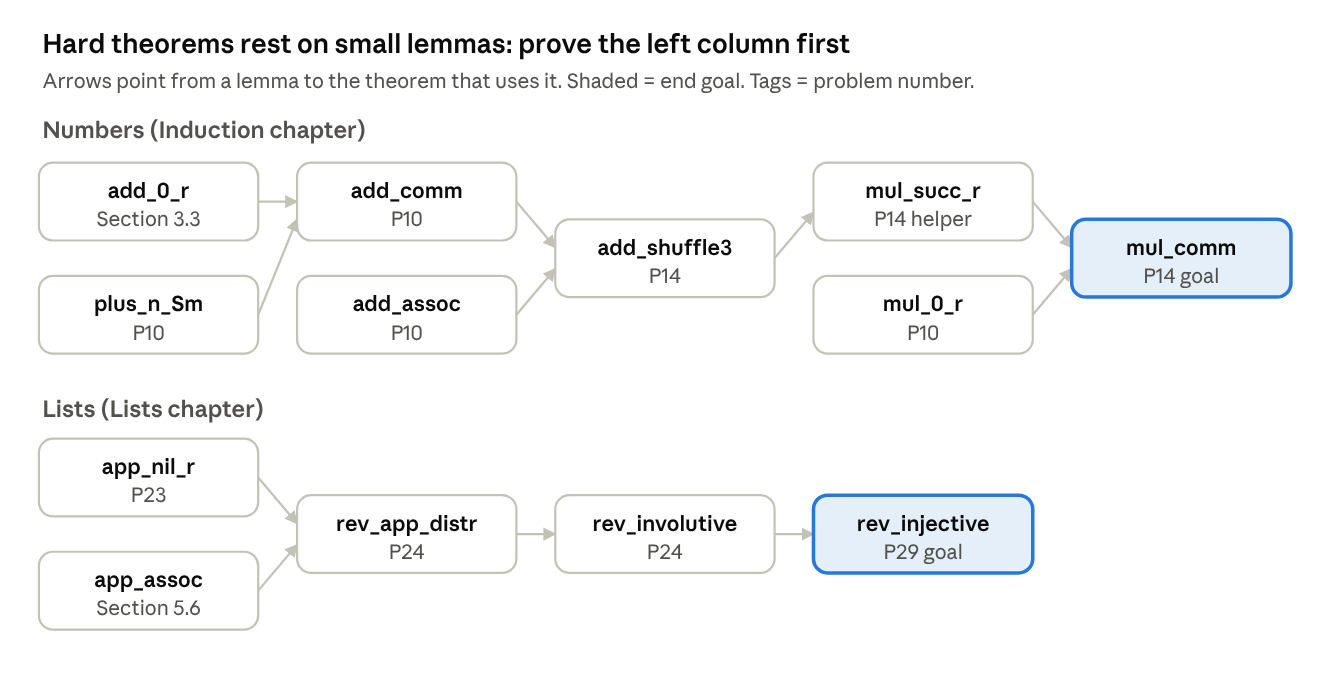
Prove the lemmas on the left before the theorems on the right; each end goal is only two or three steps once its lemmas exist.
7.6 Sources
- Basics: Functional Programming in Rocq
- Induction: Proof by Induction
- Lists: Working with Structured Data
Problems marked “(new)” are not from the book; their hints are untested sketches, so run them in Rocq before relying on them.