Agentic Verification of Software Systems (AutoRocq)
1. Bridge to the Paper
This section connects my earlier tutorial, Proof Solving in Rocq: From First Proofs to Advanced Tactics, to the paper Agentic Verification of Software Systems (AutoRocq, FSE 2026). Figure 1 of the paper proves one lemma extracted from a C program. Below are the lemma, a map of where each tactic appears in its proof, and a line-by-line walkthrough.
Prerequisites: this post builds on that tutorial. Read these sections there first:
- Section 2 (Basics), especially 2.10–2.12: what a proof is,
rewrite, anddestruct. - Section 3 (Induction): 3.2 (why
simplgets stuck onn + 0), 3.5 (replace) and 3.8 (Search). - Section 4.1: integers (
Z,%Z,Z.abs,is_sint32). - Sections 4.2.1–4.2.9: the nine tactics Figure 1 uses:
assumption,t1; t2,lia,subst,exfalso,apply,assert,replace … in Handdestructon an “or”. Section 1.2 below shows where each one appears in Figure 1.
1.0 Figure 1 for reference
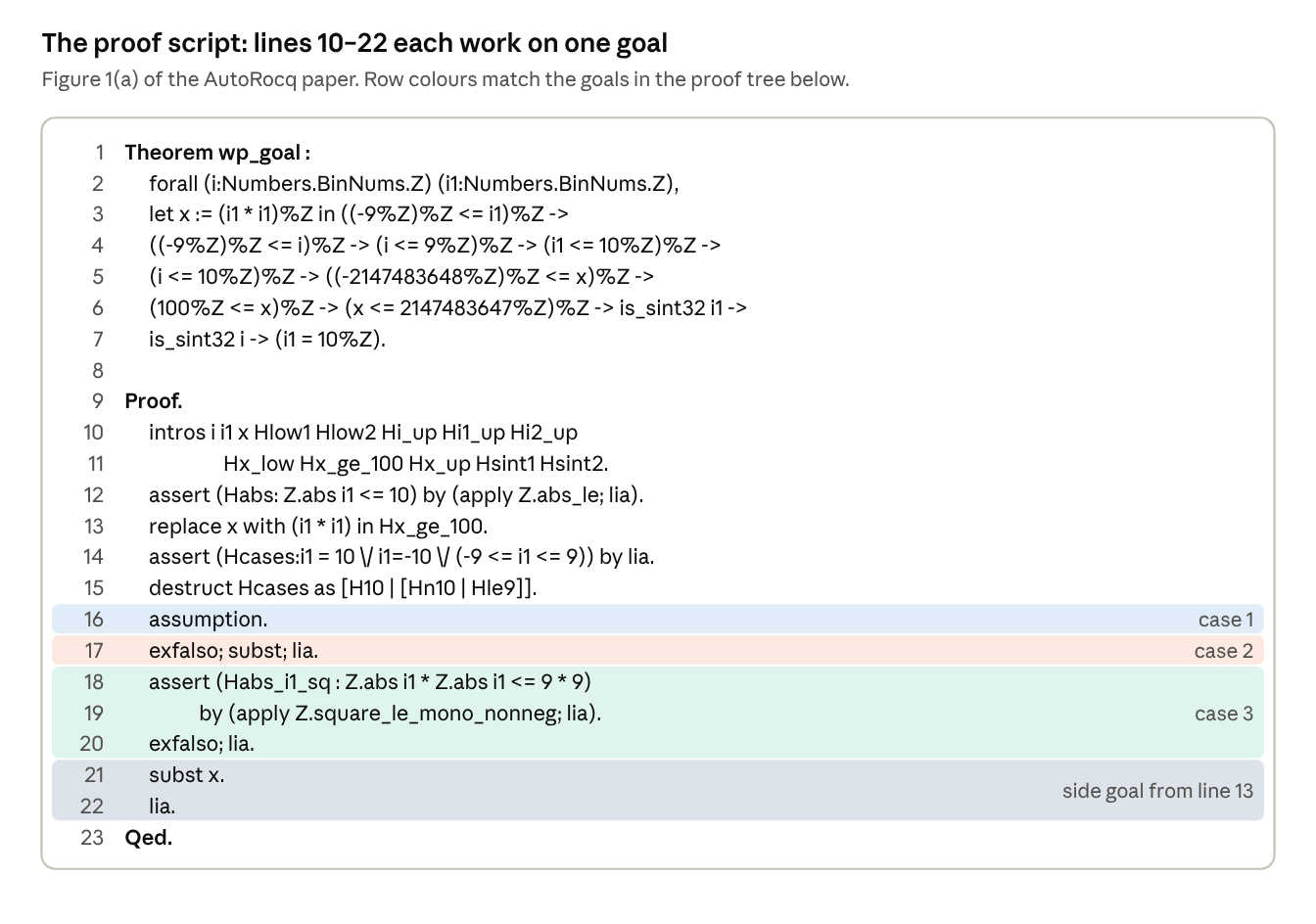
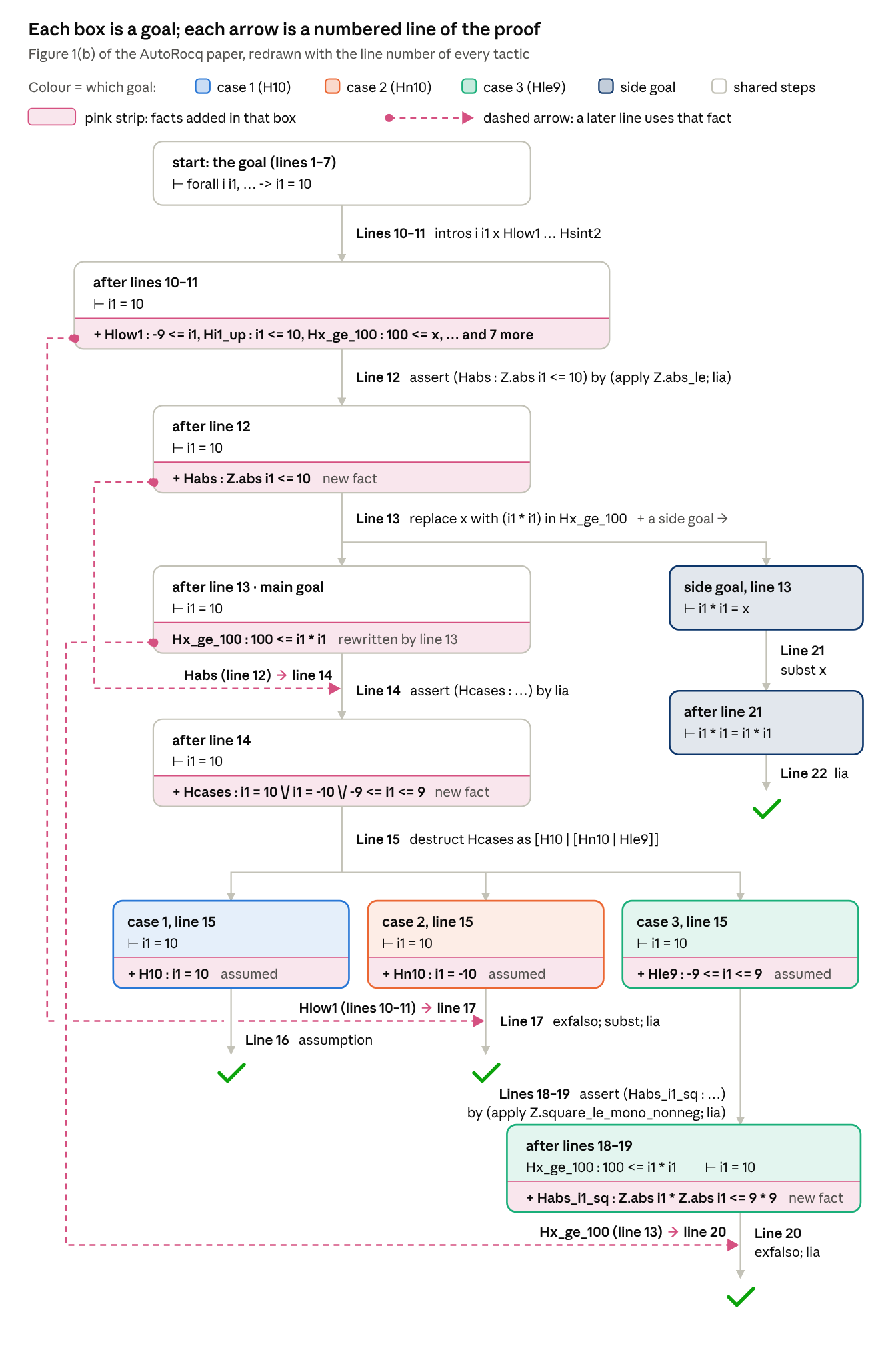
Redrawn from Figure 1 of Tu et al., “Agentic Verification of Software Systems”, Proc. ACM Softw. Eng. 3, FSE (2026), doi:10.1145/3808164, CC BY-NC-ND 4.0, with line numbers added to the proof tree. Top: the proof obligation wp_goal extracted from an SV-COMP program, and AutoRocq’s proof. Bottom: the proof tree built while proving.
Line numbers in 1.3 refer to the proof script above.
1.1 Reading the lemma
Here is the lemma from Figure 1(a), lines 1–7, with the %Z markers dropped for readability:
1
2
3
4
5
6
7
8
9
10
11
12
13
14
Theorem wp_goal :
  forall (i i1 : Z),
  let x := i1 * i1 in
  -9 <= i1 ->                (* Hlow1      *)
  -9 <= i ->                 (* Hlow2      *)
  i <= 9 ->                  (* Hi_up      *)
  i1 <= 10 ->                (* Hi1_up     *)
  i <= 10 ->                 (* Hi2_up     *)
  -2147483648 <= x ->        (* Hx_low     *)
  100 <= x ->                (* Hx_ge_100  *)
  x <= 2147483647 ->         (* Hx_up      *)
  is_sint32 i1 ->            (* Hsint1     *)
  is_sint32 i ->             (* Hsint2     *)
  i1 = 10.
In plain words: for any integers i and i1, let x be i1 * i1. If all ten conditions hold, then i1 = 10.
let x := i1 * i1 injust givesi1 * i1the short namex.- Each
->is an assumption, exactly as in the Proof Solving tutorial (Section 2.11). The comments show the names the proof gives them.
Why is it true? i1 lies between -9 and 10. If i1 were between -9 and 9, then i1 * i1 would be at most 81, contradicting 100 <= x. So i1 must be 10.
1.2 Where Figure 1 uses each tactic
Each tactic is taught in the Proof Solving tutorial (see the prerequisites). This table shows where it appears in the proof of wp_goal; line numbers refer to the proof script in 1.0.
| Tactic | In the Proof Solving tutorial | Where Figure 1 uses it |
|---|---|---|
assumption | 4.2.1 | Line 16 closes the case where H10 : i1 = 10 and the goal is i1 = 10. |
t1; t2 | 4.2.2 | Line 17, exfalso; subst; lia, chains three tactics on one goal. |
lia | 4.2.3 | Finishes almost every branch. Because lia can’t multiply unknowns, the agent first proves a fact about Z.abs i1 * Z.abs i1 with a lemma (line 18). |
subst | 4.2.4 | Line 17 replaces i1 with -10. Line 21 (subst x) does the same for the local definition x := i1 * i1. |
exfalso | 4.2.5 | The cases i1 = -10 (line 17) and -9 <= i1 <= 9 (line 20) are impossible, so both start with exfalso. |
apply | 4.2.6 | Line 12 uses apply Z.abs_le, which turns Z.abs i1 <= 10 into -10 <= i1 <= 10. |
assert … by … | 4.2.7 | Lines 12, 14 and 18 add the facts Habs, Hcases and Habs_i1_sq. Lines 12 and 18 prove theirs with a lemma (4.2.7.2): Z.abs_le and Z.square_le_mono_nonneg. |
replace … in H | 4.2.8 | Line 13 turns Hx_ge_100 : 100 <= x into 100 <= i1 * i1, and leaves the side goal i1 * i1 = x for lines 21–22. |
destruct on an “or” | 4.2.9 | Line 15 splits Hcases into its three cases. Line 14 goes the other way: lia proves the “or” fact (4.2.9.3). |
1.3 Walking through Figure 1, line by line
Line numbers refer to Figure 1(a).
1.3.1 Line 10: introduce everything
Line 10, intros i i1 x Hlow1 … Hsint2. This introduces both integers, x, and the ten assumptions under the names in 1.1. The goal is now i1 = 10.
1.3.2 Line 12: derive |i1| ≤ 10 with Z.abs_le so that we can destruct into separate cases later
Line 12, assert (Habs : Z.abs i1 <= 10) by (apply Z.abs_le; lia).
The library lemma it uses:
1
2
Z.abs_le : forall a b : Z,
  Z.abs a <= b <-> -b <= a <= b
In plain words: |a| ≤ b is the same as -b ≤ a ≤ b.
The proof after by, step by step:
- To prove:
Hlow1 : -9 <= i1, Hi1_up : i1 <= 10, … ⊢ Z.abs i1 <= 10 apply Z.abs_le.applymatchesatoi1andbto10. As a consequence, we now need to prove the right-hand side,-10 <= i1 <= 10.- To prove:
Hlow1 : -9 <= i1, Hi1_up : i1 <= 10, … ⊢ -10 <= i1 <= 10 liasolves this directly fromHlow1andHi1_up.
Back in the main proof, the context now contains Habs : Z.abs i1 <= 10, and the main goal i1 = 10 is unchanged.
1.3.3 Line 13: replace x inside Hx_ge_100 so that it can be used in one of the destruct cases later (case 3, line 20)
Line 13, replace x with (i1 * i1) in Hx_ge_100. Hx_ge_100 becomes 100 <= i1 * i1. This also creates a side goal, i1 * i1 = x, which is handled last (lines 21–22).
1.3.4 Line 14: using Habs from 1.3.2, split i1 into its three possible cases (destructed on line 15)
Line 14, assert (Hcases : i1 = 10 \/ i1 = -10 \/ (-9 <= i1 <= 9)) by lia.
Here lia uses Habs (|i1| ≤ 10), which we proved on line 12, to derive these three conditions.
1.3.5 Lines 15–20: split into cases and close each one
Line 15, destruct Hcases as [H10 | [Hn10 | Hle9]]. Three goals, one per alternative, as in the Proof Solving tutorial, 4.2.9.
- Case
i1 = 10(line 16,assumption). The goali1 = 10is exactlyH10. Done. - Case
i1 = -10(line 17,exfalso; subst; lia). Impossible:Hlow1says -9 ≤ i1.exfalsomakes the goalFalse,substreplacesi1with -10 everywhere, andliaspots -9 ≤ -10 as a contradiction. - Case -9 ≤ i1 ≤ 9 (lines 18–20). This case needs more work, so here it is step by step.
- Spot the contradiction and pick the route. If -9 ≤ i1 ≤ 9 is true, then i1 · i1 ≤ 81. But
Hx_ge_100says100 <= i1 * i1. Both can’t hold, so the hypotheses contradict each other and we take theexfalsoroute (Proof Solving tutorial, 4.2.5). To get there, we first need the fact “i1 · i1 ≤ 81” in the context.liacan’t prove it alone, because it can’t multiply unknowns. Prove the bound with a lemma (line 18). The lemma is:
1
Z.square_le_mono_nonneg : forall n m : Z, 0 <= n -> n <= m -> n * n <= m * m
In plain words: if n is between 0 and m, then n · n ≤ m · m.
The agent asserts the fact it wants:
1
assert (Habs_i1_sq : Z.abs i1 * Z.abs i1 <= 9 * 9) by (apply Z.square_le_mono_nonneg; lia)
- To prove:
⊢ Z.abs i1 * Z.abs i1 <= 9 * 9 apply Z.square_le_mono_nonnegmatches the lemma’s conclusionn * n <= m * m, with n →Z.abs i1and m →9. What’s left to prove are the lemma’s two preconditions:0 <= Z.abs i1andZ.abs i1 <= 9.; liaruns on both.0 <= Z.abs i1holds for any absolute value.Z.abs i1 <= 9follows from the case hypothesis -9 ≤ i1 ≤ 9.- Both preconditions are proved, so
Habs_i1_sqis added to the context.
Why
Z.abs i1and noti1? The lemma needs 0 ≤ n, and i1 can be negative (say -5).Z.abs i1is never negative, and |i1| · |i1| equals i1 · i1 anyway.- To prove:
Prove
Falsewithexfalso; lia. The context now holds:1 2
Hx_ge_100 : 100 <= i1 * i1 Habs_i1_sq : Z.abs i1 * Z.abs i1 <= 9 * 9
exfalsochanges the goal fromi1 = 10toFalse.liacomputes 9 * 9 = 81 and works out thatZ.abs i1 * Z.abs i1is the same asi1 * i1. So the two facts say i1 · i1 ≥ 100 and i1 · i1 ≤ 81. No number is both, soliaprovesFalseand the case is closed.
- Spot the contradiction and pick the route. If -9 ≤ i1 ≤ 9 is true, then i1 · i1 ≤ 81. But
1.3.6 Lines 21–22: close the side goal from replace
Lines 21–22, the side goal from replace: subst x. lia. The goal is i1 * i1 = x. subst x replaces x with its definition i1 * i1, leaving i1 * i1 = i1 * i1, which lia closes. Then Qed.
1.4 Connecting back to the paper’s ideas
- Proof tree (Fig. 1b, §4.2). The root is the original goal.
replaceanddestructcreate the branches: three cases plus the side goal. Each leaf is a goal closed byassumptionorlia. This is the tree AutoRocq keeps track of. - Context search (§4.1, Table 1).
Z.abs_leandZ.square_le_mono_nonnegweren’t in the lemma; AutoRocq found them with queries likeSearch (Z.abs _ <= _).. That is theSearchcommand from the Proof Solving tutorial (Section 3.8). - Why the result is trustworthy (§6.5). However the tactics were chosen,
Qedmakes Rocq’s kernel recheck the whole proof. A wrong LLM suggestion simply fails; it can never produce a false “proved”. - Human vs. agent (§6.4, Fig. 9). The human expert instead wrote two helper lemmas and split on the sign of
i1. Both proofs rest on the same fact: i1² ≥ 100 forces |i1| ≥ 10.
2. The Paper’s Main Contributions
1. An agent that works with Rocq, not just through it.
- The problem: Frama-C turns a C program and its spec into goals like
wp_goal, but someone still has to prove them. - Earlier tools: they either predict one tactic at a time from a trained model (Proverbot9001, QEDCartographer), or have an LLM write a whole proof and then repair it (if erroneous) (PALM, Rango, Copra). The authors ran all five on their benchmark and show that none of them could prove a lemma as complex as
wp_goal. - What’s new: AutoRocq is the first proof agent: an LLM (GPT-4.1, with no training on proof corpora) that talks to Rocq in a loop. At every step it decides whether to try a tactic or first ask Rocq a question.
- Why it’s safe:
Qedmakes Rocq’s kernel recheck the whole proof, so a wrong guess can only fail; it can never produce a false “proved”.
2. Three ingredients, all visible in our example.
- Context search (§4.1): the agent decides when it is missing a fact and queries Rocq (as Rocq loads all the lemmas and definitions that can be used in generating proofs).
Search (Z.abs _ <= _).surfacedZ.abs_le(line 12), andSearch (_ * _ <= _ * _).surfacedZ.square_le_mono_nonneg(line 19). Neither lemma appears in the goal. - Proof-tree awareness (§4.2): the agent keeps the tree from 1.0 (the side goal from line 13, the three cases from line 15), so it always knows which goals are still open.
- Feedback (§4.3): every Rocq error goes back to the LLM to fix the tactic. After three repeated errors the agent runs a context search instead, and it reuses successful past proofs.
- In numbers: for
wp_goal, 48 of its 59 tactic attempts failed, yet it found the proof in 156.7 seconds; a Rocq expert needed 20 minutes for a different proof (§6.4).
3. A program-verification benchmark and the results.
- New benchmark (§5.1): existing datasets (CoqGym, CoqStoq) are mostly mathematics, so the authors extracted lemmas from 131 SV-COMP C programs, using Frama-C plus LLM-generated loop invariants.
- Main results: AutoRocq proves 48.0% of the CoqGym math lemmas and 30.9% of the verification lemmas. That beats five baselines by 15.2–172.8% on math and 10.6–204.6% on verification, and 168 lemmas are proved by AutoRocq alone.
- Ablation (Table 3): removing context search hurts the most: the success rate drops from 44.3% to 30.0%.
- Linux kernel case study (§7): on code such as
memmove,strcpyandhex2bin, it proves 12 of 60 lemmas, or 18 when it can also call CoqHammer.