The range of verification techniques: from model checking to interactive proof
The three approaches differ in who writes the proof and how much the result covers. Bounded model checking needs no proof but covers only runs up to a bound. Rocq covers everything, but you write every step. Verus sits in between: you write the key facts (invariants), and Z3 works out the rest.
1. The spectrum
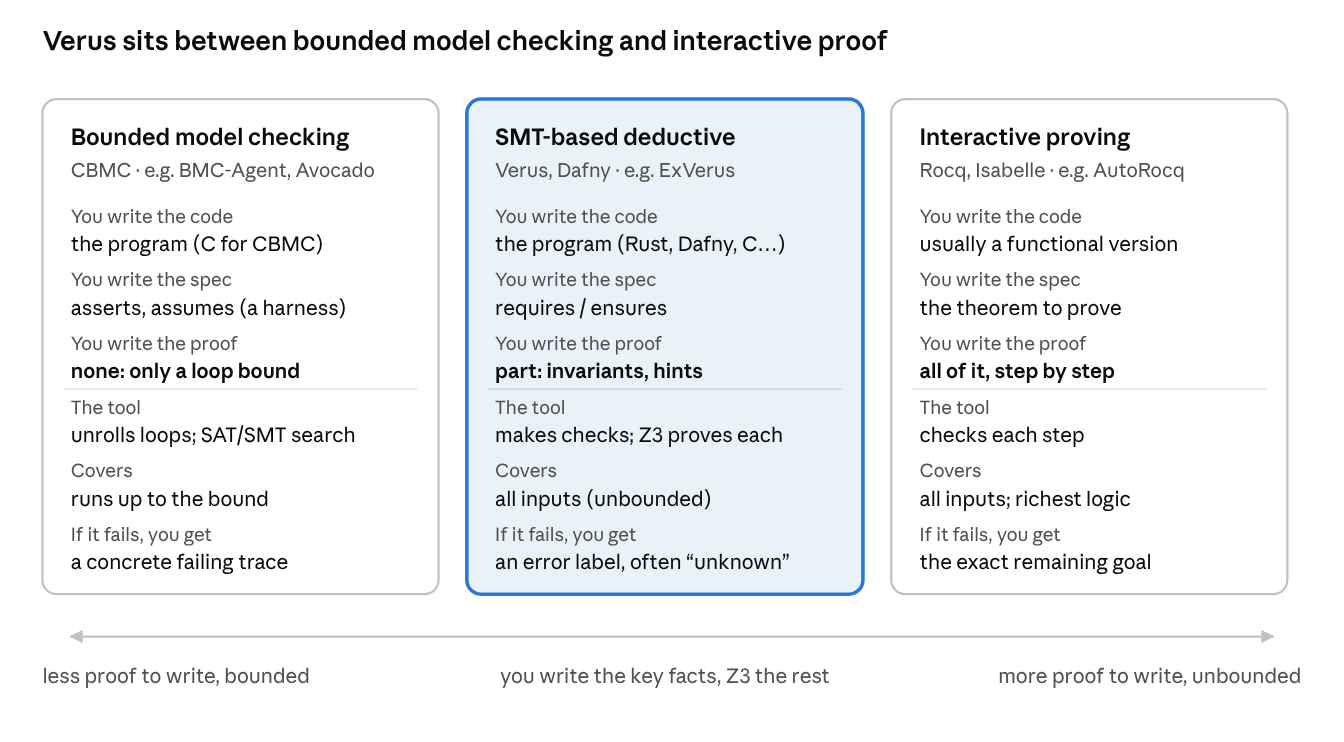
Figure 1: Where SMT-based deductive verification sits between bounded model checking and interactive proving. Examples of agentic papers at each point: BMC-Agent and Avocado (CBMC), ExVerus (Verus), AutoRocq (Rocq).
2. Hello world: one claim, three tools
The program starts at x = 0 and adds 2, n times. The claim: the result is 2n. All three versions below were run and pass (CBMC 5.95, Verus 0.2025.07.12, Rocq/Coq 8.18).
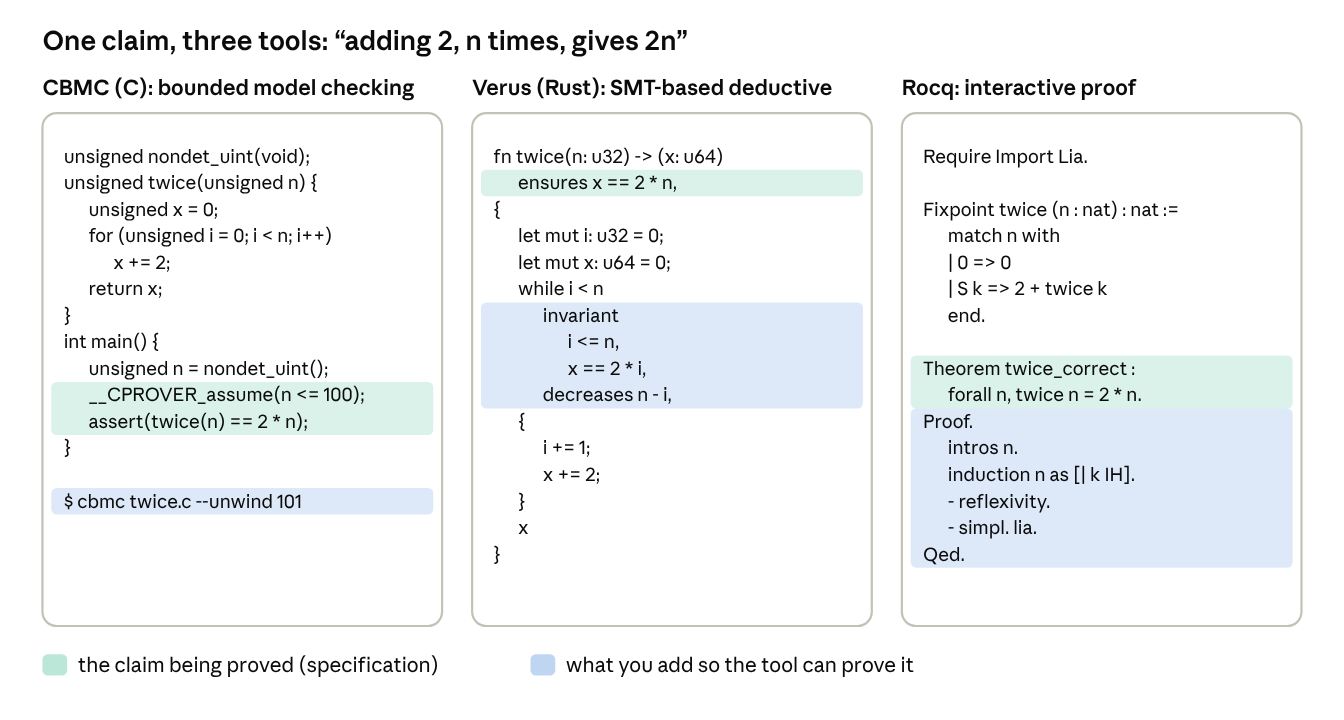
Figure 2: The same claim proved with CBMC, Verus and Rocq. Green: the claim being proved. Blue: what you must add so the tool can prove it.
Table 1: What each version needs and what it proves
| Tool | What you add beyond the code | What gets proved | How the tool gets there |
|---|---|---|---|
| CBMC | A bound on n and an unrolling limit (--unwind 101) | The claim for every n ≤ 100, and nothing beyond | Unrolls the loop 100 times and asks a SAT solver for a failing run |
| Verus | One loop invariant, x == 2 * i, plus decreases | The claim for every u32 value of n, with no bound: x is a u64, so 2n always fits | Generates three checks for the loop; Z3 proves each one. (1) Entry: at i = 0, x = 0, the invariant holds (0 == 2 · 0). (2) One iteration: if x == 2 · i and i < n, then after the body x + 2 == 2 · (i + 1). (3) Exit: when the loop stops, i = n, so x == 2 · n. |
| Rocq | A proof script: induction on n, then lia for the arithmetic | The claim for every natural number n | Checks each step you write; nothing is searched for you |
Three things to notice:
- The bound plays a different role. In CBMC the bound is essential: the tool can only unroll a fixed number of iterations. Verus needs no bound: the invariant works for any n, and making
xau64means 2n always fits (2^64at max). Rocq is valid for infinitely large values. - The invariant is the whole proof in Verus.
x == 2 * iis exactly the fact the Rocq proof establishes by induction. Verus asks you only for that fact and lets Z3 do the induction step for you. - Rocq usually proves a functional version. The loop is written as a recursive function, which is standard in Rocq.
Companion to ExVerus: Counterexample-Guided Verus Proof Repair.